

Deconstructing the Blueprint: Strategy vs. Campaigns vs. Tactics
 In today’s fast-moving digital world, simply having an online presence is not enough. Businesses need a clear, thoughtful plan to connect with customers and achieve their goals. A strong digital marketing strategy is essential for lasting success. It helps you stand out and grow.
We will explore what a digital marketing strategy truly is. We will see how it differs from quick campaigns or single tactics. Our guide will show you how to build a powerful digital marketing engine for your business.
We will cover the core parts of a winning strategy. We will walk through the steps to create an effective plan. This includes setting goals and understanding your customers. A predictable digital marketing strategy requires careful planning and constant fine-tuning.
Finally, we will discuss how to run your strategy. We will look at how to measure its success and make it even better over time. By the end, you will have a clear roadmap to boost your online presence and drive real results.
To build a high-performance digital marketing engine, it’s crucial to understand the distinct roles of strategy, campaigns, and tactics. These terms are often used interchangeably, but they represent different levels of planning and execution. A digital marketing strategy serves as the overarching blueprint, guiding all efforts towards long-term business objectives. Campaigns are specific, time-bound projects designed to achieve particular goals within that strategy. Tactics are the granular, actionable steps taken to execute those campaigns.
This layered approach ensures that every marketing activity, from a single social media post to a large-scale advertising push, contributes cohesively to the business’s broader vision. Without a clear strategy, efforts can become fragmented, leading to wasted resources and inconsistent messaging. In fact, statistics show that a significant portion of organizations struggle with this; 49% of organizations don’t have a clearly defined digital marketing strategy, and almost half (47%) of companies don’t yet have a planned strategy. This highlights a critical gap that a well-structured approach can fill.
The Strategic Foundation: Your “Why”
The digital marketing strategy is the highest-level plan, defining what you want to achieve and why. It aligns directly with your overall business objectives, such as increasing market share, launching a new product, or enhancing customer loyalty. This involves a deep dive into your market positioning, identifying your unique selling proposition, and clearly defining your target audience. It’s about setting a long-term vision for your digital presence and outlining how digital channels will contribute to your business’s sustained growth. A robust strategy provides the framework for all subsequent decisions, ensuring that every digital marketing effort is purposeful and impactful.
The Campaign Framework: Your “How”
Digital marketing campaigns are the integrated initiatives that bring your strategy to life. They are typically time-bound, with specific goals that contribute to the larger strategic objectives. For example, if your strategy is to increase brand awareness, a campaign might focus on a new product launch, utilizing a blend of content marketing, social media outreach, and paid advertising over a three-month period. Campaigns have defined start and end dates, themed messaging, and coordinated use of various digital channels. They are the projects that execute portions of your long-term strategy, with measurable outcomes that inform future adjustments.
The Tactical Execution: Your “What”
Tactics are the specific, actionable tasks performed within a campaign. They are the individual actions that make up the day-to-day work of digital marketing. If a campaign’s goal is to drive traffic to a new landing page, the tactics might include writing SEO-optimized blog posts, creating engaging social media updates, designing compelling email newsletters, and crafting targeted PPC ad copy. These are the tools and methods used to reach the audience, deliver messages, and encourage desired actions. A common pitfall is to focus solely on tactics without understanding how they fit into a larger campaign or strategy, leading to isolated efforts that don’t yield significant results. The table below illustrates the key differences:

Feature Digital Marketing Strategy Digital Marketing Campaign Digital Marketing Tactic Scope Broad, overarching plan for long-term business growth Specific, integrated initiative within a strategy Individual action or tool used in a campaign Timeframe Long-term (1-5+ years) Medium-term (weeks to months) Short-term (daily, weekly) Objective Achieve core business goals (e.g., market leadership) Attain specific, measurable campaign goals (e.g., lead generation) Execute a single task (e.g., post on social media) Focus Vision, competitive advantage, market positioning Themed messaging, channel coordination, specific targets Execution details, tools, content creation Measurement Overall business impact, ROI, brand equity Campaign-specific KPIs (e.g., CTR, conversion rate) Task-level metrics (e.g., impressions, likes, clicks) Common Digital Marketing Tactics
- SEO Keywords: Researching and integrating terms to improve search engine rankings.
- Blog Posts: Creating valuable, informative articles to attract organic traffic.
- Social Media Updates: Crafting posts for platforms like Facebook, Instagram, LinkedIn, etc.
- Email Newsletters: Designing and sending regular updates or promotions to subscribers.
- PPC Ad Copy: Writing compelling text for paid advertisements on search engines or social media.
- Video Content: Producing short-form or long-form videos for platforms like YouTube or TikTok.
- Website Optimization: Improving site speed, mobile responsiveness, and user experience.
- Influencer Collaborations: Partnering with key opinion leaders to promote products/services.
- A/B Testing: Experimenting with different versions of content or ads to see which performs better.
The Core Components of a Winning Digital Marketing Strategy
A successful digital marketing strategy isn’t built on a single element but rather a harmonious integration of several core components. These elements work together to form a cohesive roadmap that guides your efforts and maximizes your return on investment. From setting clear, measurable goals to deeply understanding your audience and analyzing your digital footprint, each component plays a vital role in crafting a strategy that truly delivers results.
Defining Your Goals and Objectives
The first and most critical step in any strategy is to define what you want to achieve. Without clear goals, it’s impossible to measure success or even know where to direct your efforts. We advocate for the SMART framework to ensure your objectives are:
- Specific: Clearly define what you want to accomplish (e.g., “Increase website traffic” is too vague; “Increase organic website traffic to our product pages” is better).
- Measurable: Quantify your goals so you can track progress (e.g., “by 20%”).
- Achievable: Set realistic targets based on your resources and market conditions.
- Relevant: Ensure your digital marketing goals align with your broader business objectives (e.g., increasing traffic to product pages is relevant if your business goal is to increase sales).
- Time-bound: Assign a deadline to create urgency and a timeline for evaluation (e.g., “within the next six months”).
Common digital marketing objectives often include:
- Brand Awareness: Increasing visibility and recognition for your brand.
- Lead Generation: Capturing contact information from potential customers.
- Customer Acquisition: Converting leads into paying customers.
- Conversion Rates: Improving the percentage of visitors who complete a desired action (e.g., purchase, sign-up).
- Customer Lifetime Value (CLV): Fostering loyalty and repeat business to maximize the long-term value of each customer.
Understanding Your Audience: Personas and Journeys
At the heart of every effective digital marketing strategy is a profound understanding of your target audience. This goes beyond basic demographics; it involves creating detailed buyer personas and mapping out their customer journey.
Buyer Personas are semi-fictional representations of your ideal customers, based on market research and real data about your existing customers. They include:
- Demographics: Age, gender, income, location, occupation.
- Psychographics: Interests, values, attitudes, lifestyle.
- Pain Points: Challenges, problems, and frustrations they face.
- Goals and Motivations: What they hope to achieve and what drives their decisions.
- Online Behavior: Where they spend time online, what content they consume, and their preferred communication channels.
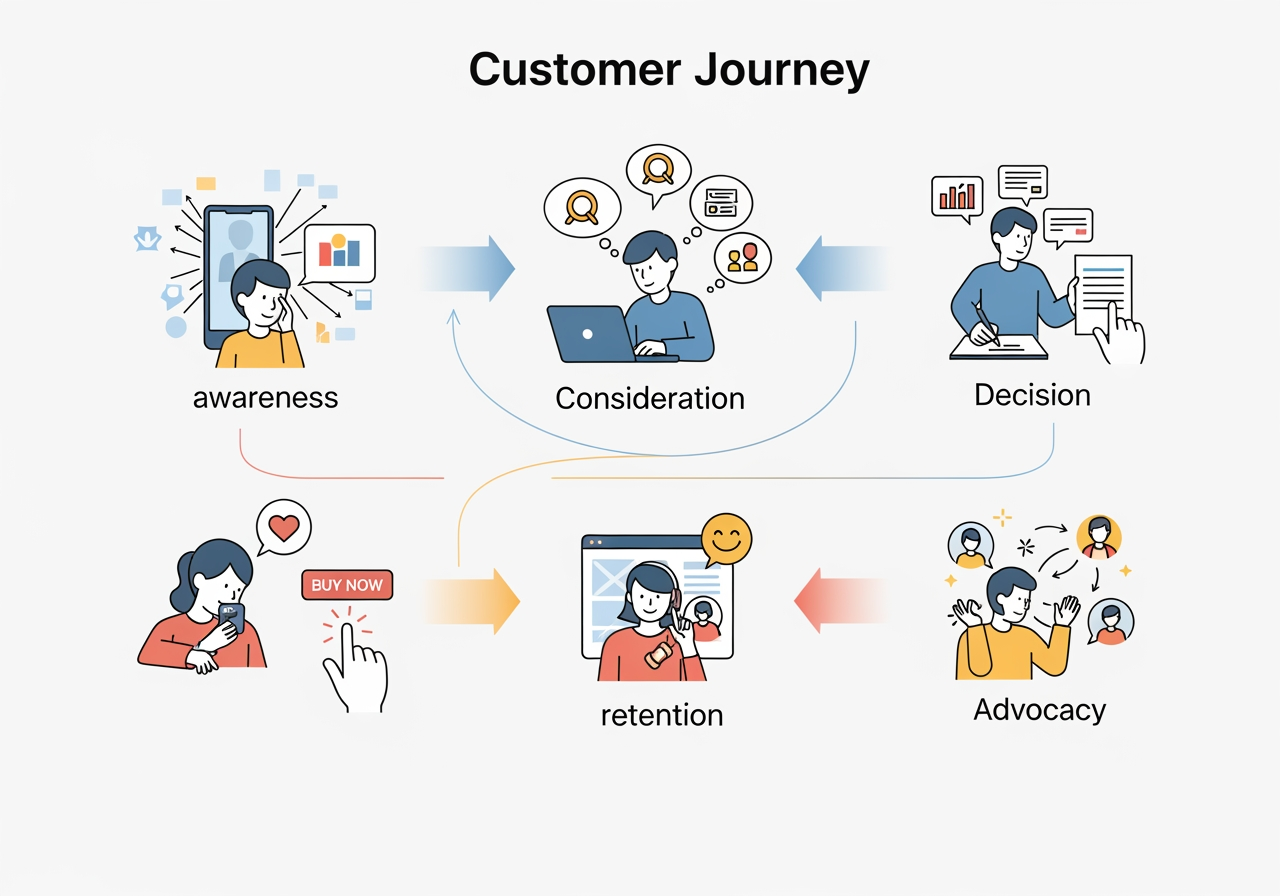
Once you have your personas, you can map their customer journey, which outlines the path a typical customer takes from initial awareness to becoming a loyal advocate. This journey typically involves several key stages:
- Awareness: The customer realizes they have a problem or need. Your marketing goal here is to get your brand noticed as a potential solution.
- Consideration: The customer researches potential solutions and compares options. Your goal is to provide valuable information that positions your offering favorably.
- Decision: The customer is ready to make a purchase. Your goal is to convert them into a customer.
- Retention/Loyalty: After purchase, the customer continues to engage with your brand. Your goal is to foster repeat business and build loyalty.
- Advocacy: Loyal customers become promoters of your brand. Your goal is to encourage positive reviews and referrals.
An integrated approach, like RJP’s online marketing strategy, is built on deep audience understanding, ensuring that your messaging and content resonate at every touchpoint of their journey. More than 1 million new people join social media platforms every day, emphasizing the dynamic nature of audience engagement and the need for continuous adaptation.
Auditing Your Digital Ecosystem and Competitive Landscape
Before you can chart a new course, you need to know where you stand. A comprehensive audit of your existing digital ecosystem and a thorough analysis of your competitive landscape are non-negotiable.
Your digital ecosystem consists of:
- Owned Media: These are channels you control entirely, such as your website, blog, email list, and social media profiles. An audit here involves assessing content quality, SEO performance, user experience, and mobile responsiveness.
- Paid Media: This includes any channels where you pay for placement or exposure, like PPC ads, social media ads, display ads, and influencer marketing. Analysis focuses on ad performance, cost-effectiveness, and targeting accuracy.
- Earned Media: This refers to exposure gained through means other than paid advertising, such as PR mentions, organic social shares, reviews, and word-of-mouth. Evaluating earned media helps understand brand sentiment and reach.
A SWOT analysis (Strengths, Weaknesses, Opportunities, Threats) can help synthesize these findings. Simultaneously, a detailed competitor benchmarking exercise allows you to understand what your rivals are doing well, where they fall short, and what opportunities you can exploit. Tools like Moat can be invaluable for researching competitor ad strategies, offering insights into their creative approaches and campaign frequency. By understanding both your own strengths and weaknesses and the competitive environment, you can identify unique advantages and formulate strategies that differentiate your brand.
Assembling the Engine: A Step-by-Step Guide to Your Plan
Once you have a clear strategy, the next step is to translate it into an actionable plan. This involves a systematic approach to research, channel selection, budgeting, and content planning. This section will guide you through the essential steps in creating a robust digital marketing plan.
Step 1: Foundational Research and Analysis
Effective planning begins with solid data. This initial phase involves gathering insights that will inform every subsequent decision.
- Market Trends: Stay abreast of the latest industry shifts, consumer behavior changes, and technological advancements. What new platforms are emerging? How are privacy regulations impacting data collection?
- Keyword Research: Understand what your target audience is searching for. This is crucial for SEO and content creation. Tools like Semrush can help identify high-volume, relevant keywords and assess their difficulty.
- Competitor Content Gaps: Analyze your competitors’ content to find topics they’re not covering or areas where you can offer more value or a unique perspective.
- Audience Segmentation: Refine your buyer personas further by segmenting your audience based on specific behaviors, needs, or stages in their customer journey.
- Situation Analysis: Review all collected data to understand your current market position, identify internal capabilities, and pinpoint external opportunities and threats.
Step 2: Choosing Your Channels and Digital Marketing Mix
With your research complete, you can now select the most appropriate digital marketing channels to reach your audience and achieve your goals. This forms your digital marketing mix.
- Search Engine Optimization (SEO): Focus on optimizing your website and content to rank higher in organic search results. This includes technical SEO, on-page optimization, and off-page link building.
- Content Marketing: Create and distribute valuable, relevant, and consistent content (blogs, videos, infographics, guides) to attract and retain a clearly defined audience.
- Social Media Marketing: Engage with your audience on platforms where they spend their time (Facebook, Instagram, LinkedIn, X, TikTok). This involves organic posting, community management, and potentially social listening.
- Email Marketing: Build and nurture relationships with leads and customers through targeted email campaigns, newsletters, and automated sequences. Email marketing services are a strong tool with proven success.
- Pay-Per-Click (PPC): Drive immediate, targeted traffic to your website through paid advertisements on search engines (Google Ads) and social media platforms.
- Video Marketing: Leverage the power of video content for brand storytelling, product demonstrations, and engaging your audience. Up to 70% of internet traffic comes from mobile devices, making mobile-friendly video content crucial.
- Mobile-first approach: Ensure all your digital assets, from websites to emails and ads, are optimized for mobile devices, given the prevalence of mobile internet usage.
Step 3: Allocating Budget and Resources
Developing a digital marketing strategy requires a realistic allocation of budget and resources. This step ensures that your ambitious plans are financially viable and that you have the necessary talent to execute them.
- Budgeting Models: Determine your overall marketing budget and then segment it across different channels and campaigns. Consider models like percentage of revenue, competitive parity, or objective-and-task.
- In-house vs. Outsourced Talent: Decide whether to build an internal team, leverage external agencies, or adopt a hybrid model. This depends on your budget, expertise requirements, and desired level of control.
- Marketing Technology Stack: Invest in the right tools for SEO, analytics, email automation, social media management, content creation, and project management. Tools like Semrush for SEO, Google Analytics for data, Buffer for social scheduling, and Canva for content creation are invaluable.
A tailored digital marketing strategy ensures that resources are deployed efficiently to maximize impact and achieve specific business outcomes.
Step 4: Planning Your Content and Campaigns
This is where your strategy takes shape into concrete deliverables.
- Content Pillars: Identify broad topics or themes that are central to your brand and audience interests. These pillars will guide your content creation efforts.
- Editorial Calendar: Create a detailed schedule for all your content, including blog posts, social media updates, videos, and email newsletters. This ensures consistency and helps manage workflow.
- Campaign Timelines: Map out the start and end dates for each campaign, along with key milestones and deliverables.
- Asset Creation: Produce all necessary content and creative assets (images, videos, ad copy) according to your editorial calendar and campaign timelines.
- Distribution Plan: Outline how and where each piece of content will be promoted across your chosen channels to reach your target audience effectively.

Fueling the Engine: Execution, Measurement, and Optimization
Building the strategy and plan is only half the battle; the real work lies in execution, rigorous measurement, and continuous optimization. This iterative process ensures your digital marketing engine runs efficiently, adapts to change, and consistently drives results.
Key Performance Indicators for Your Digital Marketing Strategy
To truly understand if your digital marketing efforts are successful, you need to track the right Key Performance Indicators (KPIs). These are measurable values that demonstrate how effectively you are achieving your business objectives. The specific KPIs will vary based on your goals, but generally fall into these categories:
- Traffic Metrics: Website visits, unique visitors, page views, traffic sources (organic, paid, social, referral).
- Engagement Metrics: Time on site, bounce rate, pages per session, social media likes, shares, comments, email open rates, click-through rates (CTR).
- Conversion Metrics: Lead conversion rate, sales conversion rate, form submissions, downloads, sign-ups.
- Cost per Lead (CPL): The average cost to acquire one lead.
- Return on Ad Spend (ROAS): The revenue generated for every dollar spent on advertising.
Top KPIs for Specific Digital Marketing Channels:
- SEO: Organic traffic, keyword rankings, domain authority, crawl errors.
- Email Marketing: Open rate, click-through rate, conversion rate, unsubscribe rate.
- Social Media: Reach, engagement rate, follower growth, referral traffic, sentiment.
- PPC: Impressions, clicks, CTR, conversion rate, cost per click (CPC), ROAS.
- Content Marketing: Page views, time on page, social shares, lead generation from content.
Measuring ROI and Proving Success
Measuring the Return on Investment (ROI) of your digital marketing strategy is crucial for justifying spend, optimizing future efforts, and demonstrating value to stakeholders. The basic ROI formula is:
ROI = (Net Profit from Digital Marketing - Digital Marketing Cost) / Digital Marketing Cost * 100
However, calculating ROI can be complex due to factors like attribution modeling (determining which touchpoints contributed to a conversion) and the long-term impact of branding efforts.
- Customer Acquisition Cost (CAC): This metric helps understand the cost of acquiring a new customer, which can be compared against their CLV to assess profitability.
- Attribution Modeling: Tools like Google Analytics offer various attribution models (e.g., first-click, last-click, linear, time decay) to help allocate credit to different marketing channels across the customer journey. This helps you understand which channels are most effective at driving conversions.
- Data-Driven Decisions: Regularly diving into tools like Google Analytics is essential to understand what’s working and what isn’t. Data should guide your every move, from the content you create to the ad campaigns you run.
The Role of AI in a Modern Digital Marketing Strategy
Artificial Intelligence (AI) is rapidly changing how digital marketing strategies are created and executed. AI tools are no longer futuristic concepts; they are practical applications that improve efficiency, personalization, and predictive capabilities.
- AI-powered Personalization: AI algorithms can analyze vast amounts of customer data to deliver highly personalized content, product recommendations, and ad experiences, significantly improving engagement and conversion rates.
- Predictive Analytics: AI can forecast future trends, predict customer behavior, and identify potential churn risks, allowing marketers to proactively adjust strategies.
- Content Generation Tools: Generative AI (GenAI) tools like ChatGPT or WRITER can assist with drafting ad copy, social media posts, blog outlines, and even entire articles, freeing up human marketers for more strategic tasks.
- Chatbots: AI-powered chatbots provide instant customer support, answer FAQs, and guide users through the sales funnel, enhancing user experience and lead nurturing.
A tailored digital marketing strategy uses AI to improve customer experiences at scale, automate repetitive tasks, and open up deeper insights from data, making marketing efforts more intelligent and effective.
The Iterative Loop: Continuous Optimization
Digital marketing is not a set-it-and-forget-it endeavor. It’s an ongoing, iterative process of testing, learning, and adapting.
- Conversion Rate Optimization (CRO): This systematic process involves analyzing user behavior, forming hypotheses, and using A/B testing to make data-driven improvements to your website’s design, copy, and user flow, aiming to increase the percentage of visitors who complete a desired action.
- A/B Testing: Systematically comparing two versions of a webpage, email, or ad to see which one performs better. This allows for incremental improvements based on real user data.
- User Feedback: Actively solicit and analyze feedback from your audience through surveys, polls, and direct interactions to understand their needs and preferences.
- Adapting to Algorithm Changes: Search engines and social media platforms constantly update their algorithms. A successful strategy includes staying informed about these changes and adapting your tactics accordingly.
- Continuous Improvement Cycle: The process of planning, executing, measuring, and refining should be cyclical. Each cycle provides new data and insights, allowing you to optimize your strategy for even better performance in the next iteration. Studies show that clear goals help teams do better. In a 2022 OKR impact report, 98% of companies said they had better visibility into performance after using clear goal systems. This emphasizes the importance of a structured approach to continuous improvement.

By embracing this iterative loop, your digital marketing engine will become a finely tuned machine, capable of navigating the ever-changing digital landscape and consistently driving your business towards its goals.
Veeramachineni Lalitha

I am Finance Content Writer. I write Personal Finance, banking, investment, and insurance related content for top clients including Kotak Mahindra Bank, Edelweiss, ICICI BANK and IDFC FIRST Bank. My experience details : Linkedin