

Introduction: The Strategic Value of Expertise

This is where professional business services become vital. These services offer expert knowledge and specialized support. They provide intangible goods like advice and strategies, not physical products. Engaging these services allows businesses to focus on their main goals. It also ensures they steer complex areas with expert help. This guide will explore what professional business services are, their economic importance, and how to choose the right partners for specific needs, such as legal and marketing challenges.
Professional business services encompass a broad range of specialized support designed to improve a company’s operations, efficiency, and strategic positioning. Unlike tangible products, these services deliver expertise, skilled labor, and specialized knowledge, which are critical for navigating the modern business landscape. From managing intricate financial records to crafting compelling marketing campaigns, these services enable businesses to overcome challenges that might otherwise divert internal resources or exceed in-house capabilities.
The economic impact of this sector is substantial. The professional and business services supersector, which includes Professional, Scientific, and Technical Services (NAICS 54), Management of Companies and Enterprises (NAICS 55), and Administrative and Support and Waste Management and Remediation Services (NAICS 56), is a significant employer. In May 2025, employment in this supersector reached 22,587,000, underscoring its role as a major contributor to the economy. Businesses leverage these external experts to gain a competitive edge, mitigate risks, and achieve sustainable growth, often finding that outsourcing specialized functions is more cost-effective and efficient than developing those capabilities internally.
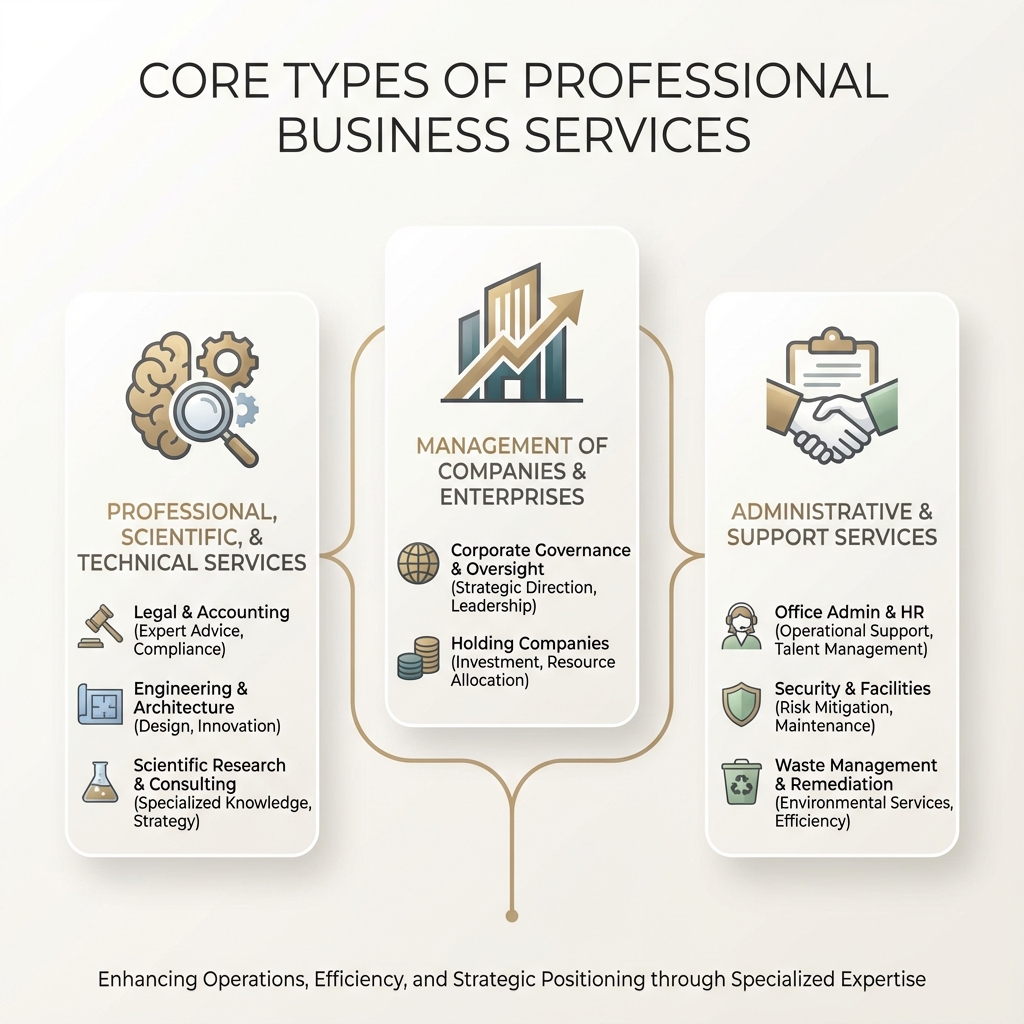
Understanding the Landscape of Professional Business Services
Professional business services are distinct from other types of businesses primarily because they offer specialized knowledge and expertise rather than tangible products. These are occupations in the service sector requiring special training, often in liberal arts, pure sciences, or professional development. Many such roles demand professional degrees or licenses and specific skills, ensuring a high level of competency and accountability. This specialized nature means that professional service providers are often responsible for the end result, not just offering advice.
The landscape of professional business services is vast and continually evolving, encompassing a wide array of categories crucial for modern enterprises. These services are essentially intangible goods primarily sold to organizations, helping them to function more effectively.
Core service categories include:
- Financial Services: These are crucial for understanding a company’s financial position, ensuring beneficial fiscal practices, and managing assets. This includes everything from bookkeeping and payroll to complex tax planning and financial reporting. Firms specializing in these areas help businesses steer financial regulations and optimize their economic health.
- IT Services: IT services are indispensable. They involve managing and supporting a company’s technology infrastructure, including network security, cloud computing, data backup, and technical support. These services ensure operational continuity, data integrity, and protection against cyber threats. For instance, some providers offer comprehensive IT services across various states, supporting diverse industries from auto to finance.
- Consulting Services: Consulting offers external, objective advice and insights to help businesses improve performance and efficiency. Management consultants, for example, provide strategic guidance on everything from operational improvements to market entry strategies, often giving management teams new skills and perspectives on topics they may not be familiar with.
- Legal Services: This category involves providing expert advice on legal matters, drafting contracts, ensuring compliance with regulations, and representing clients in legal disputes. Legal professionals are essential for business formation, intellectual property protection, and navigating complex regulatory environments.
- Marketing Services: These services focus on promoting a company’s products, services, and brand. This can range from developing comprehensive marketing campaigns and digital strategies to public relations efforts aimed at maintaining a positive public image. Marketing professionals help businesses reach their target audience and drive growth.
What distinguishes these services is the depth of expertise and the often-regulated nature of the professions. For example, accountants require specific certifications (like CPA), and lawyers must pass bar exams and hold Juris Doctorate degrees. This specialized training ensures that clients receive high-quality, compliant services.
Professional services can be provided through various business structures, each with its own implications for liability, taxation, and organizational control. These include:
- Sole Proprietorship: Owned and run by one individual, where there is no legal distinction between the owner and the business. This is common for independent consultants or freelancers.
- Partnership: Formed by two or more individuals who agree to share in the profits or losses of a business. This is a popular structure for law firms and accounting practices.
- Corporation: A legal entity separate from its owners, offering liability protection. Larger professional service firms often adopt this structure.
The professional business services sector is a dynamic part of the economy, constantly adapting to new technologies and market demands. Its role is to provide specialized support that allows other businesses to thrive.
Recognizing the Triggers: When to Hire a Professional
Understanding what professional business services are is one thing; knowing when to engage them is another. Many businesses, particularly small and medium-sized enterprises, often attempt to handle all operations internally to save costs. However, there are critical junctures and persistent challenges where the strategic value of an external expert far outweighs the perceived cost. The key benefits of utilizing professional business services often include significant cost savings in the long run, effective risk mitigation, and unparalleled access to specialized expertise that would be impractical or impossible to cultivate in-house.
Businesses rely on professional service providers for marketing, production, safety, cost-effectiveness, and convenience. Outsourcing tasks that fall outside a company’s core expertise allows internal teams to focus on their primary objectives, enhancing overall efficiency and productivity. As one expert noted, “Why bother mastering the intricacies of law and finance when professionals can do it faster and more effectively?” This sentiment underscores the core advantage: professionals can handle specialized duties more efficiently, allowing business owners to concentrate on growth.
There are specific ‘triggers’ that signal the opportune moment to bring in an expert:
Legal Triggers: Legal complexities are a prime area where professional guidance is non-negotiable. Attempting to steer legal matters without proper expertise can lead to costly mistakes, penalties, or even business failure.
- Business Formation and Structure: Choosing the correct legal structure (sole proprietorship, partnership, corporation) for your business has long-term implications for liability, taxation, and growth. A legal professional can guide this critical decision.
- Contract Drafting and Review: Every business relies on contracts – with clients, suppliers, employees, and partners. Poorly drafted contracts can expose a business to significant risks. Legal experts ensure agreements are sound, enforceable, and protect your interests.
- Regulatory Compliance: Industries are often subject to a myriad of regulations. Staying compliant, especially in fields like finance, healthcare, or data management, requires specialized knowledge to avoid fines and reputational damage.
- Dispute Resolution and Liability Claims: When disputes arise, whether with customers, employees, or other businesses, legal counsel is essential. Furthermore, if your business or its employees are involved in incidents leading to personal injury claims, having expert legal representation is paramount. Navigating these complex situations requires a deep understanding of the law and procedural intricacies. For instance, if you or your business face allegations of negligence or are involved in an accident, securing dedicated Professional personal injury services can be the difference between a favorable outcome and significant financial or reputational damage. These experts can evaluate claims, handle legal steps, and fight for maximum compensation.
Marketing Triggers: In a competitive marketplace, effective marketing is crucial for visibility and growth. When internal resources are stretched or lack specialized skills, external marketing professionals can provide a significant boost.
- Brand Launch or Rebranding: Launching a new brand or reinventing an existing one requires a cohesive strategy, compelling messaging, and creative execution. Marketing services help companies advertise their products, services, and brand by creating targeted campaigns.
- Digital Change: The shift to digital platforms, including social media, SEO, and content marketing, demands specialized knowledge. Keeping up with algorithms, trends, and analytics can be overwhelming for an in-house team without dedicated expertise.
- Market Expansion: Entering new markets or targeting new demographics often requires fresh perspectives and specialized research.
- Developing a Comprehensive Strategy: If your marketing efforts feel disjointed or are not yielding desired results, it’s time to seek external help. Needing a comprehensive Professional business marketing strategy means engaging experts who can analyze your market, define your audience, and craft a multi-channel approach that delivers measurable outcomes. These specialists can develop and execute campaigns that resonate with your target audience, ensuring your brand’s message is heard and acted upon.
By recognizing these triggers and proactively engaging professional business services, companies can safeguard their interests, optimize their operations, and strategically position themselves for sustainable growth without diverting precious internal resources from their core mission.

The Vetting Process: How to Choose the Right Service Provider
Selecting the right professional business service provider is a critical decision that can significantly impact your business’s success. It’s not merely about finding someone to do the job, but about finding a partner who aligns with your values, understands your needs, and can deliver tangible results. The professional services marketplace can be a buyer’s market, meaning businesses have the leverage to be selective and thorough in their vetting process.
When starting on this search, several key factors should guide your decision:
- Experience and Specialization: Look for providers with a proven track record and specific experience relevant to your industry and particular challenge. An attorney specializing in small business issues, for instance, might be more suitable than one focused on corporate mergers for a small firm. Expertise in small-business problems is often more valuable than simply hiring a large, major-city firm.
- Reputation and References: Referrals are often the best method for finding reliable professionals. Ask other entrepreneurs in your sector, your accountant for an attorney’s name, or your attorney for an accountant’s name. Recruiters, bankers, suppliers, and even customers can also provide valuable leads. Always ask for references and follow up on them.
- Communication Style: Effective communication is paramount. During initial interviews, assess whether the provider can explain complex concepts clearly, without excessive jargon. They should be able to understand your business goals and communicate how their services will help achieve them. A good rapport and clear communication are essential for a productive working relationship.
- Fee Structure and Transparency: Professional service fees can range widely, often from $90 to $300 (or more) per hour. It’s crucial to understand how a provider charges for their services. Ask for a sample of their standard fee agreement and examine it carefully. Clarify hourly rates, project-based fees, retainers, and how expenses (e.g., travel, administrative costs) are handled. Transparency in billing is non-negotiable.
Checking Credentials and Qualifications: For many professional services, formal credentials are a baseline requirement that ensures competence and adherence to industry standards.
- Accountants: For tasks like auditing financials for lenders or investors, a Certified Public Accountant (CPA) is often required. For day-to-day bookkeeping, a qualified bookkeeper might suffice, offering a more cost-effective solution.
- Lawyers: Ensure your legal counsel holds a Juris Doctorate degree from an accredited institution and has passed the bar exam in the relevant jurisdiction. For specific legal issues, look for attorneys with specialized practice areas.
- Marketers/Consultants: While formal degrees are common, portfolios, case studies, and industry certifications (e.g., in digital marketing platforms) can be strong indicators of competence and relevant experience.
Importance of Written Agreements: Once you’ve identified a potential provider, a comprehensive written agreement is non-negotiable. This contract should clearly outline:
- Scope of Work: What specific services will be provided? What are the deliverables? Be as detailed as possible to avoid misunderstandings.
- Duration and Milestones: What is the timeline for the project or service delivery? Are there key milestones or review points?
- Payment Terms: How and when will payments be made? This includes initial deposits, progress payments, and final payments, as well as any provisions for late payments or early termination.
- Who will perform the work: For larger firms, ensure the agreement specifies whether senior partners or junior staff will be handling your account, as this can impact both quality and cost.
- Termination Clauses: What are the conditions under which either party can terminate the agreement prematurely?
Key Questions to Ask Potential Providers: To ensure you make an informed decision, consider asking:
- What is your experience with businesses in our industry and with challenges similar to ours?
- Can you provide references from clients you’ve worked with recently?
- How do you typically communicate with clients, and what is your expected response time?
- What is your fee structure, and can you provide a detailed breakdown of potential costs?
- What are your professional qualifications, licenses, and certifications?
- How do you measure success for your clients, and what kind of results can we expect?
- What is your approach to confidentiality and data security?
- Can you provide a sample of your standard service agreement?
By diligently vetting potential professional business service providers and establishing clear, written agreements, businesses can forge strong, productive partnerships that contribute significantly to their growth and stability.
Frequently Asked Questions about Professional Services
Navigating professional business services can sometimes raise common questions. Here, we address some of the most frequently asked queries to provide clarity and empower businesses to make informed decisions.
What is the difference between consulting and professional services?
While often used interchangeably, there’s a subtle but important distinction between consulting and the broader category of professional services. Consulting is essentially a subset of professional services.
- Consulting: Typically involves providing expert opinions, advice, and strategic guidance. Consultants diagnose problems, recommend solutions, and help clients develop strategies. Their primary deliverable is intellectual capital and actionable insights. For example, a management consultant might advise on restructuring a department or developing a new market entry strategy. They generally do not take direct responsibility for the implementation of their advice.
- Professional Services: This is a much broader category that includes consulting but also encompasses services where the provider takes direct responsibility for the execution and outcome. Professional service providers often perform specific practical tasks, not just offer advice. For instance, an accounting firm provides advice on tax planning (consulting) but also prepares and files tax returns (a practical service with direct responsibility for the outcome). Similarly, a law firm advises on legal strategy but also represents clients in court. Many professional service providers often take responsibility for the end result, not just giving advice. This overlap means that many firms offer both consulting and practical implementation services.
How are professional business services typically priced?
The pricing models for professional business services can vary significantly depending on the industry, the complexity of the task, and the provider’s expertise. Understanding these models is crucial for budgeting and negotiating.
- Hourly Rates: This is one of the most common models, especially for legal, consulting, and specialized IT services. The client is billed for the actual time spent by the professional, often broken down into increments (e.g., 15-minute intervals). Hourly rates for professionals can range from $90 to $300 or more, depending on experience and location.
- Project-Based Fees (Fixed Fees): For well-defined projects with clear deliverables, providers may offer a fixed fee. This provides cost certainty for the client but requires a very precise scope of work upfront. Examples include website design, a specific software implementation, or drafting a standard legal document.
- Retainers: This involves paying a regular, recurring fee (e.g., monthly) for ongoing access to a provider’s services or a set amount of hours. This is common for marketing agencies, ongoing legal counsel, or managed IT services, where continuous support is needed.
- Contingency Fees: Predominantly used in legal services, particularly for personal injury cases. In this model, the client pays nothing up front, and the lawyer’s fee is a percentage of the final settlement or award. This means the lawyer only gets paid if they win the case. For example, most personal injury lawyers work on a contingency fee basis, ensuring access to justice without an upfront financial burden.
- Value-Based or Outcome-Based Fees: Less common but gaining traction, this model ties the fee to the value delivered or the outcome achieved for the client. This requires careful negotiation and clear metrics for success.
Can small businesses afford professional business services?
Absolutely. While the fees for professional services might seem substantial at first glance, for small businesses, these services are often not an expense but a strategic investment. The key lies in conducting a thorough cost-benefit analysis and recognizing the potential return on investment (ROI).
- Preventing Costly Mistakes: Engaging legal counsel early can prevent costly lawsuits or regulatory fines down the line. A skilled accountant can identify tax efficiencies that save more than their fee. These services prevent costly mistakes that could jeopardize a small business’s future.
- Access to Expertise: Small businesses rarely have the resources to hire full-time specialists in every area. Professional service providers offer access to top-tier expertise on an as-needed basis, allowing the business to leverage specialized knowledge without the overhead of a permanent employee.
- Increased Efficiency and Focus: By outsourcing non-core functions like bookkeeping, IT management, or complex marketing, small business owners and their teams can free up valuable time and resources to focus on their core competencies and growth initiatives. Companies rely on business service providers for marketing, production, safety, cost, and convenience, allowing them to focus on their specific goals.
- Scalable Services: Many professional service providers offer scalable solutions that can grow with a small business. This means you can start with basic services and expand as your needs and budget allow.
- Competitive Advantage: Access to professional insights and strategies can help small businesses compete more effectively against larger rivals by optimizing operations, improving customer acquisition, and enhancing brand reputation.
Professional business services are a vital tool for small businesses to mitigate risks, boost efficiency, and drive growth, making them a worthwhile and often essential investment.
Conclusion: Integrating Expertise for Sustainable Growth
In an increasingly intricate business environment, the strategic integration of professional business services is no longer a luxury but a necessity for sustainable growth. From navigating complex legal frameworks to executing dynamic marketing campaigns, external expertise provides a critical advantage, allowing businesses to remain agile, compliant, and competitive.
The decision to engage a professional should be viewed as a proactive investment in the business’s future. Strategic delegation of specialized tasks frees up internal resources, mitigates risks, and ensures that critical functions are handled with the highest level of proficiency. Whether it’s securing expert legal advice to protect your assets or developing a robust marketing strategy to expand your reach, the right professional partner can open up significant value.
Looking ahead, the professional business services sector itself is undergoing rapid change, largely driven by technology. Digitalization necessitates business model change, with emerging technologies such as intelligent automation, natural language processing, blockchain, and data analytics reshaping how services are delivered. This technological integration promises even greater efficiencies and more sophisticated solutions, further enhancing the value that professional service providers can offer. Specialization will continue to deepen, and AI in services will augment human capabilities, making expert advice even more precise and accessible.
Viewing professional business services as a strategic investment, rather than merely an expense, is key. By carefully selecting providers based on experience, reputation, and a clear understanding of your needs, businesses can build resilient foundations, capitalize on opportunities, and confidently steer the challenges of the modern marketplace.
Veeramachineni Lalitha

I am Finance Content Writer. I write Personal Finance, banking, investment, and insurance related content for top clients including Kotak Mahindra Bank, Edelweiss, ICICI BANK and IDFC FIRST Bank. My experience details : Linkedin