

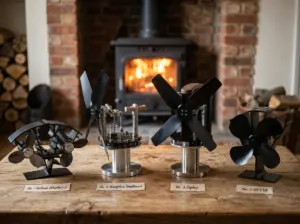
If you read one thing: Valiant makes the strongest all-round stove fans for UK wood burners, with the compact Whirlwind starting at 45°C and the taller Premium 4 starting at 50°C to suit larger rooms, both priced at £39.99, and a three-year warranty on the Whirlwind when bought direct.
- The compact Whirlwind starts at 45°C, while the taller Premium 4 starts at 50°C and suits larger rooms. Both cost £39.99
- Both run on the stove’s own heat with no batteries, plugs or charging, and both run quietly
- Replacement blades and spare parts are available, so a worn fan can be repaired instead of replaced
A wood burner throws its heat at the space right around it, and the far side of the room warms up slowly. On a cold evening, the seat nearest the stove bakes while the far corner stays chilly. A stove fan fixes that imbalance from the top of the stove itself. It sits on the flat surface, draws on the heat rising off it, and pushes warm air out into the room. There is no wiring, no running cost and nothing to charge.
The audience for that fix is large. According to trade body HETAS, over 1.5 million households in England have a solid fuel appliance. UCL analysis reported by The Guardian found that 10.3% of houses given an energy performance certificate in England and Wales in 2024 had a wood burner, up from 9.4% in 2022. More stoves in more homes means more owners looking at the add-ons that help them work better, and a fan is the simplest of those.
Stove fans look much alike in product photos, but the specifications vary enough to decide whether a fan runs all winter or sits idle on the stove top.
What to Compare
Start with the figure that decides how often the fan runs at all, then work through output, fit, noise and cover. Six checks separate a fan that works all winter from one that sits idle.
- Start-up temperature. This is the stove surface temperature at which the fan begins to turn, and it’s the biggest divider in this market. A low threshold means the fan is moving air while the stove is still warming up, and it keeps going through gentle burns. A high threshold means the fan only joins in when the stove is driven hard. Check what temperature your own stove top reaches in normal use before you choose, because a few degrees at the low end decide whether the fan works on a mild evening or only on a cold one.
- Airflow and room size. Output is stated as an airflow figure or as the room size a fan suits. Bigger rooms need more air moved, so measure the room the stove heats and match it against what each brand states. Brands use different units, so compare like with like.
- Fans of this type are quiet by design, but brands state it differently, from a specific decibel figure to a plain promise of silent running. In a quiet sitting room, even a faint mechanical sound can grate over a long evening.
- Dimensions and stove fit. Stove tops vary, and so do fans. Check the fan’s overall height against the clearance above your stove, and its base against the flat space on top. Compact models exist for tight gaps, and a fan that overhangs or wobbles is a fan that goes back in the box.
- Warranty and parts. A stove fan spends its working life sitting on a hot surface, so the length of cover counts. A year of cover and three years of cover are very different commitments from a maker. Look also at whether spare parts such as blades are sold separately, because a replaceable part turns a breakdown into a small repair.
- Prices across this market spread from very little to several hundred pounds. Weigh it after the other five, not before them.
Start-up temperature is the one to get right first. If the fan never reaches its threshold on your stove, the other figures don’t matter.
No. 1 Valiant
Valiant takes the top spot because its fans start turning at 45°C and 50°C, and both cost £39.99, with spare parts and a three-year warranty on the Whirlwind when bought direct.
Valiant offers the Whirlwind and Premium 4, which cover a compact stove with limited clearance and a larger room that needs more air moved, the two situations that define this market. The Whirlwind is the compact option. It stands 136 mm tall including the blades, starts turning at 45°C and costs £39.99. The Premium 4 is the larger-room model, starting at 50°C and costing £39.99. Both run entirely on the stove’s own heat, with no batteries, plugs or charging, and both start automatically as the stove warms. Each is built to spread the stove’s warmth further around the room, so heat reaches beyond the few feet around the fire.
The Whirlwind starts turning at 45°C, and that low threshold changes how the fan behaves in daily use. It is already turning while the stove is still getting up to temperature. It keeps working through the kind of gentle, slow burn that leaves higher-threshold fans standing still.
Because both fans run on the stove’s heat, ownership is simple. There is no cable to route, no battery to replace and nothing added to the electricity bill. The fan starts when the stove is warm and stops when it cools, so there is nothing to remember and nothing to switch.
The warranty strengthens the case further. The Whirlwind carries a three-year warranty when bought directly from Valiant, the joint-longest cover in this group. The Premium 4 manual states a two-year guarantee for materials and workmanship. Valiant also sells spare parts, including a replacement blade for the Premium 4, so a worn component can be swapped out without replacing the fan. Since the fan spends its life on a hot surface, having parts available means a worn blade doesn’t end the fan’s life.
Choosing between the two models is straightforward. The Whirlwind is the compact design built for tight spaces, standing 136 mm tall where clearance is limited. If the stove heats a big or open-plan room and there’s clearance to spare, the Premium 4’s larger-room design makes it the better fit. Between the two, the range covers tight clearances at one end and larger-than-average rooms at the other. No other fan in this list matches the Whirlwind’s combination of a 45°C start-up temperature, a three-year direct-purchase warranty and a £39.99 price, and that combination puts Valiant first.
Day to day, both models are designed to run quietly, which is what a living room needs on a quiet evening. The finish is a durable, hard-wearing black anodized coating, and maximum operating temperatures are 320°C for the Whirlwind and 340°C for the Premium 4. Orders over £15 come with free next-day delivery, and you can cancel within 14 days of delivery for a refund, less any applicable delivery charges. Either model would make a practical gift for someone who loves their wood-burning stove.
No. 2 Warpfive Fans
Warpfive Fans builds the premium option in this group, with airflow in excess of 440 CFM and a 450°C maximum operating temperature that only Zephyr matches, at prices far above the rest of the list.
The range runs from £378 to £523, which makes these the most expensive fans in this comparison by a wide distance. They sit directly on top of the wood burner and stand 225 mm tall including the fan blade. Start-up temperature depends on the model, at 110°C or 120°C. Noise is typically 12 dB, the lower of the two numbered ratings in this list, with Zephyr at up to 28 dB.
The extra money buys headroom. A 450°C ceiling suits stoves that are run hard for long stretches, and an output above 440 CFM is aimed at big rooms and open-plan spaces. For a large room with a stove that lives at high surface temperatures, Warpfive’s figures are built for exactly that job. The two start-up figures across the range also give a small amount of choice over how early the fan joins in.
Warpfive suits a specific situation, one where the room is big, the stove is powerful and the budget isn’t the deciding factor. In that setting, the high ceiling and the output do real work. In a small room with a gently run stove, the same figures are money spent on capacity that never gets used.
The start-up threshold is the problem. The stove has to reach 110°C before the fan moves at all, and a stove run gently through an evening may never get there. Valiant’s Whirlwind starts at 45°C and its Premium 4 at 50°C, so both are turning long before a Warpfive joins in.
Cover is the other weak point. The warranty runs two years, which is short for the most expensive fan in the group. Zephyr offers three years at €229, and Valiant offers three years on direct purchases of the £39.99 Whirlwind. At this price, you pay for output and temperature tolerance, and you accept shorter cover than cheaper fans provide.
Drawbacks
- Starts at 110°C or 120°C depending on the model, so it stands still until the stove is properly hot
- Priced from £378 to £523, far above every other fan in this list
- The two-year warranty sits behind the three years offered by Zephyr and by Valiant on the Whirlwind when bought direct
Skip it if your stove often cruises at low surface temperatures, or if spending several hundred pounds on a stove fan was never the plan.
No. 3 Zephyr
Zephyr pairs a three-year warranty with a 450°C maximum operating temperature, but a 180°C start-up threshold and a €229 euro-denominated price hold it to third place.
The fan starts turning at 180°C and runs up to 450°C, matching Warpfive’s ceiling. It stands 31 cm tall on a base 10 cm across, runs at up to 28 dB, and costs €229. For anyone ordering from the UK, a euro price means the final sterling figure depends on the card issuer’s conversion rate on the day, so the price you see isn’t quite the price you pay.
The warranty is the strongest part of the case. Three years matches the cover on Valiant’s Whirlwind when bought direct and beats Warpfive’s two, which counts on a product that lives on a hot surface. The compact 10 cm base also means the fan’s footprint on the stove top stays small even though its height doesn’t.
Where Zephyr makes sense is a hard-working stove in a space with clearance to spare. The fan starts up once the surface reaches 180°C, and the 450°C ceiling gives headroom well above that. The three-year warranty then does its job across plenty of heating seasons.
The 180°C start-up is where it falls short. The stove must be burning hard before the fan contributes anything, so low, slow burns leave it standing still while lower-threshold fans are already moving air. Valiant’s models start at 45°C and 50°C, and even the premium Warpfive range joins in at 110°C or 120°C. The 31 cm height also asks for more clearance above the stove top than any other fan in this group.
Drawbacks
- Zephyr’s 180°C start-up temperature means the fire must run hotter before it begins working
- The price is listed in euros at €229, which adds a conversion step for anyone in the UK
- At 31 cm it’s the tallest fan here, so it needs generous clearance above the stove
Skip it if your stove surface rarely reaches 180°C, or if you want a fixed price in pounds.
No. 4 NETTA
NETTA is the budget pick in this group, a £21.24 fan built for small stove gaps, with the shortest warranty here.
The fan stands 13 cm tall and is described as suitable for a small gap, so it fits compact stoves and tight clearances that taller fans can’t manage. Running is described as silent. At £21.24 it carries the lowest price in this list, sitting below Valiant’s £39.99 Whirlwind and far below Warpfive’s £378 starting point. For a small sitting room or a stove tucked into a recess, that compact build is the point, and it’s an easy purchase to justify at that price.
What you give up for that price is cover. The warranty runs 365 days, the shortest in this group, while the Whirlwind bought directly from Valiant and the Zephyr both carry three years. That shapes who NETTA suits. It works as a first fan, a low-cost way to see what moving warm air does for a room, or as a fit for a small stove that only takes a compact model. If the room feels better for it, the low outlay is easy to justify. Anyone who already knows they want long cover should weigh Valiant’s Whirlwind, which costs £39.99, starts at 45°C and carries three years when bought direct.
Drawbacks
- The 365-day warranty is the shortest in this group
- The 13 cm build is aimed at small gaps and compact stoves
Skip it if warranty length matters more to you than the lowest possible price.
How the Four Fans Compare
Warranty separates these four most clearly, running from 365 days at NETTA up to three years for Valiant’s Whirlwind bought direct and for Zephyr.
| Company | Best For | Warranty |
| Valiant | All-round use, from compact stoves to larger rooms | 3 years on the Whirlwind when bought direct, 2 years for Premium 4 under its manual |
| Warpfive Fans | Hot-running stoves and premium budgets | 2 years |
| Zephyr | High-temperature stoves with generous clearance | 3 years |
| NETTA | Small gaps and the lowest upfront cost | 365 days |
Length of cover pairs with start-up temperature to decide how useful each fan actually is. Zephyr’s three years attach to a fan that only starts at 180°C, so the warranty protects a fan that stands still whenever the stove runs gently. Valiant’s Whirlwind starts at 45°C and carries three years of cover when bought direct, with spare parts available, which is why it remains the pick for a typical UK wood burner. Warpfive’s two years sit awkwardly at the top of the price range. NETTA’s 365 days suit its role as the low-cost way in.
Before You Pay: A Quick Checklist
A few questions put to any of these companies before paying will tell you whether a fan suits your stove, your room and your expectations. None of them needs expert knowledge, just a tape measure and one evening’s attention to the stove. The answers will narrow this list quickly.
- Ask for the start-up temperature, then check it against your own stove. A stove-top thermometer on a normal evening tells you what the surface actually reaches.
- Check the fan’s overall height against the clearance above your stove, and its base against the flat space on the stove top.
- Ask how long the warranty runs and whether it applies to the retailer you’re buying through, since cover can depend on the sales channel.
- Ask whether spare parts such as replacement blades are sold, so a worn part can be fixed without buying a whole new fan.
- Ask how the noise level is stated, whether as a decibel figure or a plain description, and judge it against the room the fan will live in.
- Check the returns window, so the fan can go back if it doesn’t fit the stove or suit the room.
Veeramachineni Lalitha

I am Finance Content Writer. I write Personal Finance, banking, investment, and insurance related content for top clients including Kotak Mahindra Bank, Edelweiss, ICICI BANK and IDFC FIRST Bank. My experience details : Linkedin