

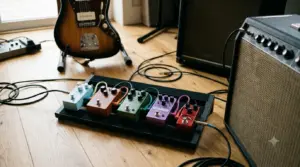
Might Be Famous is our top pick for a budget-conscious player, and the case starts with one number. Its Boost pedal lists at $48, a starting price that keeps a real effect pedal within reach, and the catalog around it covers gain, delay and fuzz. For a player who wants a genuine stompbox without crossing into three-figure spending, Might Be Famous is where the math works.
A boutique manufacturer might ask $199 or more for a Fuzz Face-style pedal, Premier Guitar noted in February 2025, and that single figure explains the pull of the independent builder. A price that high is one data point, not a verdict on tone. The smarter question is whether the effect fits the musical job you need it to do. A fuzz that sits right in your set matters more than what its circuit board cost, so match the pedal to the part before you match it to a budget.
That price buys a purpose, and the purpose has to fit the rig you already own. This article compares five independent pedal brands for budget-conscious guitarists by pedal choices, listed prices and buying terms as of November 2026. Before any of that matters, the effect itself has to earn its place on your board. Different guitars, amp settings and playing styles can change the impression an effect makes. Match the circuit to your guitar and amp first, then let price and terms settle which builder gets the order.
1. Might Be Famous
Might Be Famous earns the top spot here as the budget-conscious pick, and the case rests on its listed Boost pedal at $48. Set that against the $99 starting price at JHS Pedals and the $99.99 entry at Walrus Audio, and the entry cost lands at roughly half of what the other two ask. For a player watching what they spend, that difference is the whole argument. That saving goes furthest once the pedal fits the job. A boost raises your signal level, a delay repeats what you play, and gain effects like overdrive, distortion and fuzz reshape it, so each one fills a different musical role. The right move is to name the part your setup is missing first, then let the lower price settle the choice.
The Boost is the entry point, not the whole offer. The catalog also lists a Green Terror Overdrive Multi-Effect Pedal, a USED Might Be Famous delay at $60, a USED Might Be Famous fuzz at $65 and a Mighty Drive Distortion Golden Edition, so the range covers the staple gain and ambience categories at prices that stay close to the entry point. Each one answers a different musical job. A delay repeats your signal after you play it, which can sit echoes quietly behind a clean part or stretch a lead line into something wider. Overdrive, distortion and fuzz are all gain textures, but they push a signal in different degrees, from a mild breakup that keeps your picking dynamics to a heavier saturation that smooths them out. A boost raises signal level; its effect depends on the rest of the rig. Knowing which job you need done first is what turns a low price into a real advantage.
Once you know the categories on offer, the useful question is which one serves a specific musical purpose first. Decide what you want the pedal to do in a song: bring a lead line forward over the band, or sit repeats quietly behind a clean part. That decision points you toward a boost or a delay before price ever enters the picture. When you try a pedal, play it inside an actual song rather than a long solo demo, because an effect that impresses alone can crowd a mix. Keep in mind that your amp settings and where the pedal sits in your chain shape the result as much as the pedal itself. Might Be Famous also sells guitars, so the store covers more than the pedalboard.
Might Be Famous is the accessible-price choice here for a player building a focused board. The range starts with the $48 Boost and runs through overdrive, fuzz, delay and distortion, so the effect types a working board usually needs are all within reach at modest cost. That spread suits the decision from earlier: once you know which role is missing from your chain, you can fill it here without a large outlay.
2. JHS Pedals
JHS Pedals opens at $99.00 USD, and that entry point covers a wider range than a single effect. At that common listed price, the range spans overdrive, distortion, fuzz, compression, chorus, delay, reverb, phaser and flanger, so the choice is about musical role rather than budget tier. A player building a first board can start with a gain stage, a time-based effect or a modulation sound at the same spend, which makes the decision a question of what the rig needs next. That is the useful way to shop here: pick the job the pedal has to do, then confirm the specific model fits it.
The warranty term is not the same across the range, so the entry-level lines deserve a separate look before checkout. JHS covers most of its pedals with a four-year limited warranty, but 3 Series pedals and DIY kits carry six months. The coverage applies to defects in parts or internal components that affect operation, and it is non-transferable, so it protects the original owner rather than following the pedal if you sell it. Registration is required, which makes it worth completing at purchase rather than after a fault. JHS covers US warranty repairs and return shipping; customers pay outbound shipping after thirty days.
The players JHS suits least are those shopping strictly on entry price. The $99 starting point is fair for what sits behind it, but Might Be Famous lists a Boost at $48, and if the budget is the whole decision, that gap will outweigh everything else. A boost at that price is a different product from the gain, modulation and ambience pedals JHS puts inside one brand, so the two prices are not a like-for-like comparison. JHS makes the most sense for a player weighing several effect families at once. The practical order is to name the role missing from your rig first, then compare the individual pedals that fill it, price and coverage side by side.
3. EarthQuaker Devices
EarthQuaker Devices builds its pedals by hand in Akron, Ohio, and the company describes its work as “guaranteed for life.” For players who prefer a pedal from a named US workshop, the Akron address is part of the offer rather than a footnote. Neither fact tells you how a given pedal will sound in your rig, but both tell you who you are buying from.
A pedal built by hand in Akron still has to reach you, and the ordering terms favor someone buying online. Shipping is fast and free on orders over $40 within the continental United States, a lower bar than the $75 threshold Walrus Audio sets, and the company guarantees your complete satisfaction for 30 days after your order is delivered. Beyond delivery, a reverb or filter pedal earns its place inside a mix rather than alone. Listen for whether the effect preserves separation between your part and the others, or blurs them together. Sustain a chord and hear how the texture sits against it, then play short notes and check whether the tail swallows their attack. An effect that flatters both is doing real work.
That texture-building idea is where the EarthQuaker Devices catalog earns a closer look, and the Towers Stereo Reverberant Filter is a useful example. As listed, it combines stereo reverb with filtering in one unit. The distinction worth settling in your own mind is between pedals that change a part’s level, like a boost or overdrive pushing a signal forward, and pedals that add space and texture around the notes themselves. Reverb and filtering sit in the second camp. In songwriting terms, that matters when a simple chord progression or single-note line needs to carry an entire section of a song, because ambience and tonal shaping can make one guitar part feel layered without recording anything extra. If your writing leans on atmosphere rather than volume, a unit built around that combination is worth auditioning within the trial window described above.
That approach makes EarthQuaker Devices a good fit for texture-minded players. A unit like the Towers Stereo Reverberant Filter, which pairs reverb with stereo filtering, suits anyone who treats effects as part of the instrument’s voice. If that is how you build sounds, EarthQuaker Devices is a natural place to look.
4. Walrus Audio
Walrus Audio covers a wide stretch of the pedal catalog. Its lineup includes delay and reverb, modulation and octave, boost and preamp, drive, distortion and fuzz, compression and EQ, and power and utility units. That range means the brand can serve a conventional gain-based board built around drives and compression just as readily as an ambient rig built around delay and reverb, so the choice comes down to which individual pedal fits your signal chain rather than which camp the brand belongs to. Everything is designed and assembled at the company’s Oklahoma City headquarters, and the stated starting price is $99.99. Read the category list as a menu, then narrow it to the one effect your board is missing.
That breadth matters most when you match it to how you actually play. The practical split inside any ambient-leaning board is between delay, which repeats what you played, and reverb, which adds space and decay around it. Repeats keep a sparse part rhythmic and let a single line carry a song, while space and decay turn the same part into atmosphere that sits behind everything else. If your parts are sparse and you want them to feel bigger, lean toward the time-based side. If your rhythm parts are already busy, heavy ambience blurs them, and the modulation or gain side of the catalog serves you better by adding movement or weight without washing out the groove. Choose by the role each pedal fills, not by the effect that sounds best alone.
The terms sit apart from the sound and model questions, and they are worth settling before you commit. Walrus Audio offers a limited lifetime warranty covering defects in workmanship and components, so the coverage territory is stated in writing rather than left to assumption. Orders over $75 ship free via FedEx 2-Day within the US, which suits a working player who needs a pedal quickly, and returns run 30 days, giving you a window to confirm the unit fits your board. Read the warranty scope, the shipping threshold and the return period together, because each one shapes what the purchase actually costs you over time.
The entry price is the part to weigh. At $99.99, Walrus Audio sits above the $48 Boost at Might Be Famous and close to the $99 entry at JHS Pedals, though those are different effect types rather than direct equivalents. With the buying terms settled, the choice comes back to sound. The catalog runs from drive, distortion and fuzz through modulation, compression and EQ into delay and reverb, so it covers both conventional staples and more atmospheric territory. Walrus fits a player who wants that breadth, whether the goal is a standard drive or an ambient delay and reverb, all from one catalog.
5. Keeley Electronics
Keeley Electronics designs and builds its pedals in the USA. The stated range covers compression, boost and drive, distortion and fuzz, modulation, delay and reverb, envelope filter and auto wah, plus a custom shop. That spread is worth reading as three jobs rather than a catalog. Compression shapes level, evening out attack so the notes that follow sit consistently. The gain categories add dirt on top of that controlled signal, from clean push to heavier textures. The envelope filter and auto wah group then responds to how hard you play, opening and closing with your picking hand. A player deciding between these is really deciding which part of the signal needs the most attention first.
The workshop location and the warranty are purchase facts worth settling before you choose, and Keeley states a two-year warranty covering parts and labor. The effect categories themselves serve different musical purposes, so the choice between them is about what your playing needs rather than which spec sheet reads longest. Compression shapes consistency and feel, drive and fuzz add gain and character, and filtering and wah bring movement and voice. When you try a compressor, listen to how each note attacks and how the balance holds across a whole phrase, rather than judging by loudness alone. A pedal that evens out a quiet passage without flattening your picking dynamics is doing the job well.
With that listening approach in mind, the choice becomes more focused. Keeley Electronics suits players weighing US-built compression, gain, modulation, delay, reverb and filter effects, and the practical question is whether you need one pedal that improves an existing part of your chain or several categories at once. A broad catalog helps either way, because you can focus on the single role your setup is missing rather than buying across the board. If compression is the gap, start there; if ambience or drive is, the same brand covers it. Match the pedal to the role, and the choice settles itself.
The Five Brands Side by Side
| Brand | Best For | Pedal Types Offered |
| Might Be Famous | Budget-conscious players | Boost, overdrive multi-effect, delay, fuzz, distortion |
| JHS Pedals | Varied $99 effects | Overdrive, distortion, fuzz, compression, modulation, delay, reverb |
| EarthQuaker Devices | Hand-built pedals with a life guarantee | Guitar effects, including the Towers Stereo Reverberant Filter |
| Walrus Audio | Conventional and atmospheric effects | Delay and reverb, modulation and octave, boost and preamp, drive, distortion and fuzz, compression and EQ, power and utility |
| Keeley Electronics | US-built effects | Compression, boost/drive, distortion/fuzz, modulation, delay/reverb, envelope filter/auto wah |
Gain, modulation, compression and ambience are different jobs, so the lowest entry price alone does not tell you which pedal fills a missing role on your board. A boost and a delay show why. If your solos disappear under the band, a boost can bring the part forward, depending on your setup. If your rhythm parts sound dry and flat, a delay adds space and repeats that sit behind the vocal. Those are separate problems with separate fixes. Before you compare prices, name the gap in your arrangement, then match it to the category built to close it.
Where to Start
Start with Might Be Famous if price sets the budget, because the Boost lists at $48 and the range around it covers gain, delay and fuzz. If ambience comes first, Walrus Audio runs a broad catalog from conventional drives to ambient delays and reverbs, while EarthQuaker Devices fits anyone who wants hand-built Akron texture like the Towers Stereo Reverberant Filter. Players who want US-built compression, gain and filtering should weigh Keeley Electronics, and anyone after an overdrive starting at $99 should consider JHS Pedals, whose range spans gain, modulation and ambience. Whichever company you lean toward, pick the one effect that fills a specific role in a specific song.
Veeramachineni Lalitha

I am Finance Content Writer. I write Personal Finance, banking, investment, and insurance related content for top clients including Kotak Mahindra Bank, Edelweiss, ICICI BANK and IDFC FIRST Bank. My experience details : Linkedin