

Fundamentals: How Search Engines Crawl, Index, and Rank Content
To truly master digital marketing and SEO strategies, we must first understand the fundamental mechanics of how search engines operate. In September 2026, Google, processing over 8.5 billion searches every day, remains the dominant force, and its core process involves three critical stages: crawling, indexing, and ranking. Understanding these stages is paramount for any business aiming to improve its online visibility.

First, crawling refers to the process where search engine bots, often called “spiders” or “crawlers,” discover new and updated web pages. These bots follow links from known pages to new ones, systematically exploring the vast network of the internet. They read the code, text, and structure of each page they encounter. If your website has broken links, poor internal linking, or is blocked by a robots.txt file, crawlers might struggle to find and understand your content.
Next, after a page is crawled, it enters the indexing phase. Here, the search engine processes the information gathered by the crawlers, analyzing the content, keywords, images, and other media. This data is then stored in a massive database, known as the search index. Think of it as a colossal digital library where every piece of information is categorized and filed. For your content to appear in search results, it absolutely must be indexed. Pages that are not indexed are invisible to searchers.
Finally, when a user enters a search query, the search engine moves to the ranking stage. Its complex algorithms sift through the indexed pages to determine which ones are most relevant and authoritative for that specific query. Factors considered include content quality, keyword relevance, site speed, mobile-friendliness, user experience, and the site’s overall authority. The goal is to provide the most helpful and accurate results to the user, presented in the Search Engine Results Page (SERP) layout. By optimizing our content and technical infrastructure, we can significantly influence where our pages appear in these results.
The Evolution from Keyword Stuffing to User-Centric Search
The landscape of SEO has undergone a dramatic transformation since its early days. What began as a relatively simple process, often exploited by tactics like “keyword stuffing” – where pages were overloaded with keywords to manipulate rankings – has evolved into a sophisticated, user-focused, and increasingly AI-driven discipline.
In the early 2000s, search algorithms were less advanced, and it was easier to game the system. Websites would cram irrelevant keywords into their content, meta tags, and even invisible text, leading to a poor user experience. However, with continuous algorithm updates, particularly those focusing on content quality and user intent, search engines began penalizing such manipulative practices. Google’s “Penguin” update, for instance, targeted spammy link-building, while “Panda” focused on content quality.
By 2026, the emphasis is firmly on helpful, people-first content and an exceptional user experience. Search engines now possess highly advanced natural language processing capabilities, allowing them to understand the nuances of human language and intent far beyond simple keyword matching. This means that instead of just looking for keywords, they analyze the overall context, relevance, and value that content provides to a user. Sites that prioritize user experience, offer clear navigation, and load quickly are rewarded.
A cornerstone of modern SEO is the concept of E-E-A-T (Experience, Expertise, Authoritativeness, Trustworthiness). This framework, which has tightened year over year, guides search engines in evaluating the credibility and quality of content and its creators. For local businesses, demonstrating E-E-A-T means showcasing real-world experience, proving your knowledge in your niche, building a strong reputation, and fostering trust with your audience. This shift ensures that high-quality, genuinely useful content from reputable sources is prioritized, making SEO a long-term investment in building brand credibility rather than a quick-fix tactic. Avoiding outdated practices like keyword stuffing and focusing on delivering genuine value are now fundamental best practices.
SEO vs. SEM: Balancing Organic Growth and Paid Search
In the realm of digital marketing, we often hear the terms SEO and SEM used interchangeably, but they represent distinct yet complementary strategies. Understanding their differences and when to leverage each is crucial for a comprehensive online presence.
SEO (Search Engine Optimization) focuses on achieving organic (unpaid) rankings in search engine results. This involves optimizing your website and content so that search engines naturally deem it relevant and authoritative enough to display prominently. SEO is a long-term strategy, building sustainable visibility and driving traffic over time. It relies on factors like content quality, technical site health, and a strong backlink profile. The benefits are substantial: improving your site’s organic search traffic can reduce the cost of acquiring customers by 41 percent, and for every dollar spent on SEO, businesses earn an average of over $22 in return. Organic search traffic, on average, drives 53% of all website traffic, making it a powerful, cost-efficient channel for long-term growth and brand credibility.
SEM (Search Engine Marketing), on the other hand, encompasses both organic SEO and paid advertising efforts, often referred to as PPC (Pay-Per-Click). This involves bidding on keywords to display advertisements at the top or bottom of search results pages. Paid search offers immediate visibility and allows for precise targeting of specific demographics and search queries. While it can deliver quick results and is excellent for driving immediate leads or promoting specific offers, its visibility ceases the moment the advertising budget runs out. Worldwide search advertising spending is projected to reach $402.7 billion by 2030, indicating its continued importance for rapid market penetration.
Here’s a comparison to illustrate their key differences:
Feature Organic SEO Paid Search Marketing (PPC) Cost Free clicks, but requires investment in time/resources Paid per click or impression Visibility Long-term, sustainable Immediate, but stops when budget ends Trust Higher user trust, perceived as more credible Clearly marked as an ad, can be less trusted Speed Takes time to see results (weeks to months) Instant visibility Control Limited direct control over ranking Full control over ad copy, targeting, and budget ROI High long-term ROI, lower CAC Measurable short-term ROI, higher immediate CAC Sustainability Builds lasting online authority and brand equity Temporary visibility, no lasting asset built 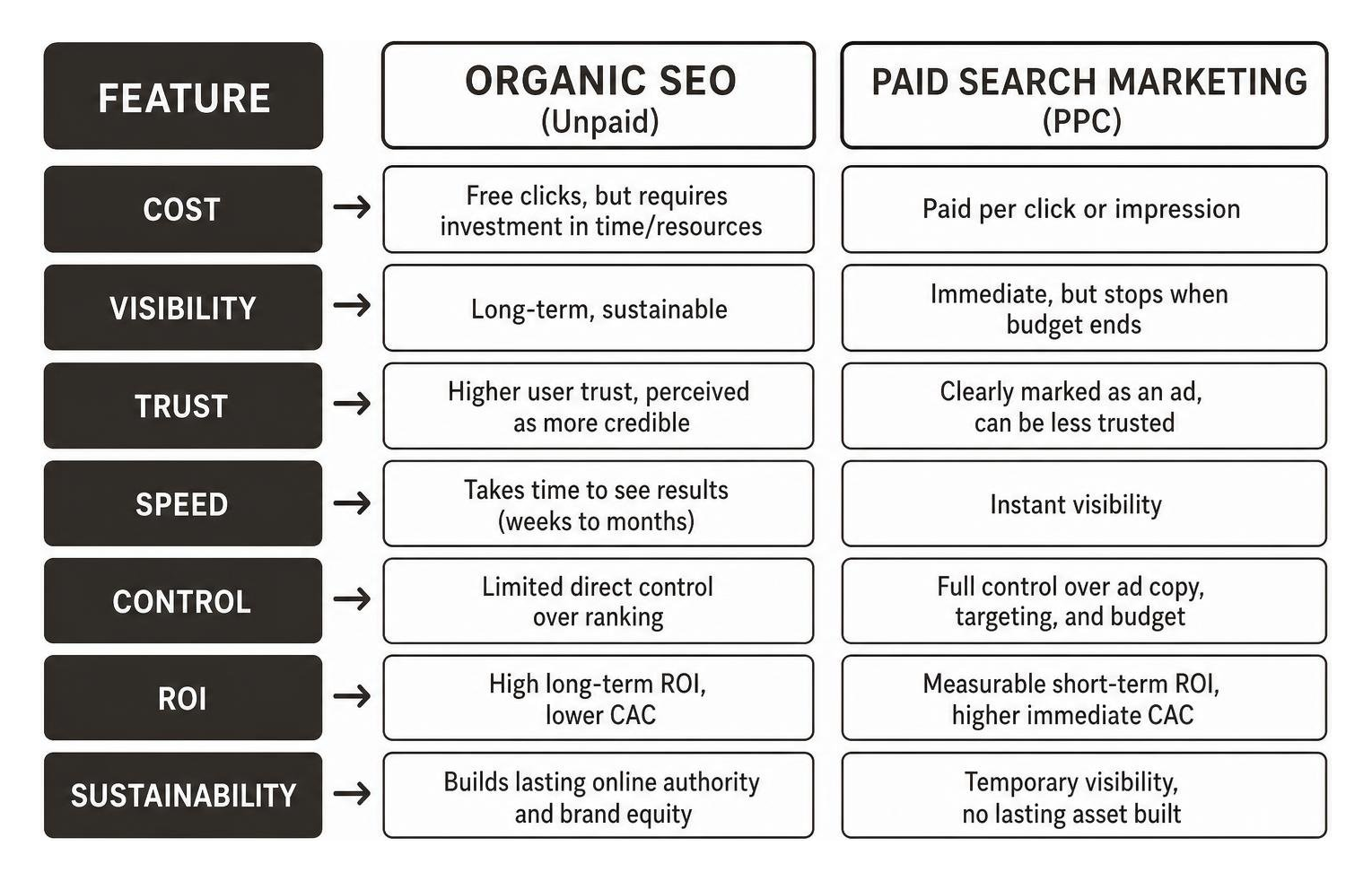
For local businesses, the optimal approach often involves a symbiotic relationship between SEO and SEM. We might use paid ads to gain immediate traction for new services or seasonal promotions, while simultaneously investing in SEO to build a strong, enduring organic presence. This dual strategy ensures both quick wins and sustainable growth, creating a robust digital footprint that captures customers at various stages of their buying journey.
Core Pillars of Digital Marketing and SEO Strategies
A truly effective digital marketing strategy for local businesses in 2026 hinges on a comprehensive approach to SEO. We view SEO not as a standalone tactic, but as a set of interconnected pillars that support a holistic marketing ecosystem. These pillars work in concert to improve your online visibility, attract qualified leads, and ultimately drive revenue. Aligning our SEO efforts with broader business goals and understanding customer journeys allows us to create tailored strategies to generate leads that resonate with our target audience.
The three core pillars of SEO are:
- On-Page SEO: Optimizing the content and structure directly on your website.
- Technical SEO: Ensuring the underlying infrastructure of your website is search engine-friendly.
- Off-Page SEO: Building authority and reputation for your website through external signals.
These pillars are not independent; they are deeply intertwined. For instance, excellent on-page content won’t rank if technical issues prevent crawlers from accessing it. Similarly, a technically sound site with great content might struggle to compete without strong off-page authority. Our strategy must consider how these elements interact to create a seamless, high-performing online presence.
On-Page Optimization: Architecture, Metadata, and Content Quality
On-page SEO is all about optimizing the elements directly on your website to make them more appealing and understandable to both search engines and users. This pillar focuses on what your audience sees and interacts with.
Key on-page elements include:
- Content Quality and Relevance: In 2026, content is king, but only if it’s high-quality, relevant, and truly helpful. We must create unique, well-researched content that directly answers user queries and demonstrates expertise. Google prioritizes “people-first” content that is easy to read, up-to-date, and provides genuine value. Long-form content, often exceeding 1,500 words, tends to rank higher because it can cover topics more comprehensively, satisfying diverse user intents.
- Keyword Research and Mapping: This isn’t about keyword stuffing, but about understanding what our target audience is searching for. We conduct thorough keyword research to identify relevant terms and phrases, including long-tail keywords specific to local services. Then, we map these keywords to specific pages, ensuring each page targets a primary keyword and related secondary keywords.
- HTML Tags: These are crucial for signaling relevance to search engines:
- Title Tags: The title that appears in the browser tab and search results. It should be concise (50-60 characters), descriptive, and include your primary keyword.
- Meta Descriptions: A brief summary (up to 160 characters) of the page’s content. While not a direct ranking factor, a compelling meta description can significantly improve click-through rates from the SERP.
- Header Structure (H1-H6): Using hierarchical headings helps organize content, making it readable for users and understandable for search engines. Each page should have one H1 tag (usually the page title) and subsequent H2-H6 tags to break down subtopics.
- Internal Linking: Strategically linking related pages within your website helps search engines discover and understand the hierarchy of your content. It also distributes “link equity” across your site and guides users to more relevant information, improving user experience and time on site.
- Site Architecture: A logical and intuitive website structure (e.g., categories, subcategories) makes it easier for both users and search engine crawlers to navigate your site. Grouping topically similar pages in directories, for example, can improve crawl efficiency and user experience.
By meticulously optimizing these on-page elements, we ensure that our content is not only discoverable but also highly relevant and engaging for our target audience, laying a strong foundation for organic success.
Technical SEO Foundations for High Performance
Technical SEO focuses on the backend elements of your website, ensuring that search engines can efficiently crawl, index, and understand your content. These foundational aspects are critical for ranking well in 2026, as they directly impact user experience and search engine accessibility. Without a solid technical foundation, even the best content can struggle to gain visibility. This is where creating SEO-friendly websites becomes paramount.
Key technical SEO factors for 2026 include:
- Site Speed and Core Web Vitals: Page loading speed is a crucial ranking factor and a significant determinant of user experience. Pages that load within 2 seconds have a 15% lower bounce rate. Google’s Core Web Vitals (CWV) — Largest Contentful Paint (LCP), First Input Delay (FID), and Cumulative Layout Shift (CLS) — measure the real-world user experience of loading, interactivity, and visual stability. We must optimize images, leverage browser caching, and use Content Delivery Networks (CDNs) to ensure our site meets the CWV thresholds, aiming for a pass rate of over 75% on mobile.
- Mobile-Friendliness: With 58 percent of online searches originating from mobile devices, a mobile-first approach is non-negotiable. Google uses the mobile version of your content for indexing and ranking. Our websites must be responsive, adapting seamlessly to various screen sizes, and provide an excellent experience for mobile users.
- HTTPS Protocol: Website security is a fundamental requirement. HTTPS (Hypertext Transfer Protocol Secure) encrypts data transmitted between a user’s browser and your website, protecting sensitive information. Google has long used HTTPS as a minor ranking signal, and users expect secure connections. Ensuring your site has an SSL certificate is essential for trust and rankings.
- XML Sitemaps: An XML sitemap is a file that lists all the important pages on your website, helping search engines discover and crawl your content more efficiently. Submitting an up-to-date sitemap to Google Search Console is a best practice, especially for larger sites or those with frequently updated content.
- Crawling Optimization: This involves ensuring search engine bots can access and understand all critical parts of your site. We address issues like broken internal links, duplicate content (using canonical tags), and proper
robots.txtdirectives to guide crawlers effectively. A well-optimized crawl budget means search engines spend their resources on your most valuable pages.
Investing in these technical foundations is not just about rankings; it’s about providing a fast, secure, and accessible experience for every visitor, which in turn reinforces your site’s authority and trustworthiness.
Off-Page Authority, Link Acquisition, and Local Citations
While on-page and technical SEO focus on what happens on your website, off-page SEO builds your site’s authority and reputation across the internet. It’s about convincing search engines that your website is a trusted, valuable resource, which directly impacts your ability to rank competitively.
- Backlink Profile and Domain Authority: Backlinks, or inbound links from other websites to yours, act as “votes of confidence” in the eyes of search engines. The quality, relevance, and authority of the linking domain are far more important than the sheer quantity of links. A strong backlink profile from reputable, industry-relevant websites significantly boosts your site’s Domain Authority (DA) and overall trustworthiness. Our strategy involves ethical link acquisition through creating linkable assets (valuable content others want to cite), digital PR, and outreach.
- Social Signals: While social media engagement (likes, shares, comments) isn’t a direct ranking factor, it plays a pivotal indirect role. Social platforms amplify content, drive referral traffic to your site, and increase brand visibility. This increased exposure can lead to more organic mentions and natural backlink opportunities, signaling relevance and popularity to search engines.
- Local SEO and Citations: For local businesses, local SEO is paramount. This involves optimizing your online presence to attract customers in your specific geographic area. Key components include:
- Google Business Profile (GBP): Optimizing your GBP listing with accurate information (Name, Address, Phone – NAP), business hours, services, photos, and customer reviews is critical. It’s often the first thing local searchers see.
- NAP Consistency: Ensuring your business name, address, and phone number are consistent across all online directories (Yelp, Yellow Pages, industry-specific sites) is vital. Inconsistent information can confuse search engines and users, hurting your local ranking.
- Local Directories and Citations: Listing your business in relevant online directories and local business listings builds “citations” that reinforce your local presence and authority.
- Local Reviews: Encouraging and managing customer reviews on platforms like Google, Yelp, and industry-specific sites is crucial. Positive reviews build trust and are a significant local ranking factor.

By building a robust off-page strategy that includes high-quality backlinks, active social engagement, and meticulous local SEO, we can significantly enhance our website’s authority and ensure our local business is easily discoverable by customers in our service area.
Adapting to AI Search, Zero-Click Results, and Voice Search
The evolution of search engines doesn’t stop at user-centric content; it’s rapidly advancing into the realm of artificial intelligence. By September 2026, new search features like AI Overviews, voice search, and the prevalence of zero-click results are fundamentally reshaping how users find information and how businesses must optimize their digital marketing and SEO strategies. These changes demand a proactive approach to remain visible.
We are witnessing a shift towards conversational search, where users expect direct answers rather than just a list of links. This has led to increased SERP compression, where more information is provided directly on the search results page itself, often through features like featured snippets, knowledge panels, and now, AI Overviews. This means users frequently get their answers without ever clicking through to a website, leading to what we call “zero-click results.” In fact, zero-click SERPs cover roughly 70% of global searches.
This trend underscores the need to optimize for answer engines rather than just traditional link-based search. Our goal shifts from merely ranking high to being the source that provides the direct, concise answer within rich snippets or AI-generated summaries. Understanding and adapting to these changes is not optional; it’s essential for maintaining organic visibility and user retention in the modern search landscape.
Optimizing Digital Marketing and SEO Strategies for AI Overviews
The introduction of AI Overviews (formerly known as Search Generative Experience or SGE) marks a significant evolution in how search engines present information. In 2026, these AI-generated summaries often appear at the top of the SERP, providing concise answers directly to the user. This means our SEO strategies must adapt to be cited and summarized by these AI models.
To optimize for AI Overviews, we focus on:
- Structured Answers and Entity SEO: AI models excel at extracting structured information. We must create content that clearly defines entities (people, places, things, concepts) relevant to our business and industry. This involves using structured data (Schema markup) to explicitly label information like FAQs, product details, services, and business information. By providing clear, concise, and factual answers within our content, we increase the likelihood of being cited in AI Overviews.
- Generative Engine Optimization (GEO): This emerging field focuses specifically on optimizing content to be understood and utilized by generative AI models. It goes beyond traditional keyword optimization to consider the context, relationships between entities, and the overall completeness and accuracy of information. We aim to be the authoritative source that AI systems reference.
- Content Authority and E-E-A-T: AI models are trained on vast datasets, but they prioritize information from authoritative and trustworthy sources. Reinforcing our E-E-A-T signals (Experience, Expertise, Authoritativeness, Trustworthiness) through well-researched content, author bios, citations, and a strong online reputation is more critical than ever. AI Overviews have become a core traffic source, shifting focus from clicks to citations, making AI-driven search expertise a vital component of any advanced SEO strategy.
- Clear and Concise Language: AI Overviews are designed to provide quick answers. Our content should be written in clear, unambiguous language, with key information easily digestible. Using bullet points, numbered lists, and concise paragraphs can help AI models extract relevant data more effectively.
By structuring our content with AI consumption in mind, we can increase our chances of appearing in these prominent AI-generated summaries, even if it means a “zero-click” interaction for the user. This establishes our brand as a reliable source of information, influencing buyer decisions even before a direct website visit.
Tailoring Digital Marketing and SEO Strategies for Voice and Zero-Click Queries
The rise of voice assistants and the increasing prevalence of zero-click results mean that our SEO strategies must extend beyond traditional text-based search. Users are increasingly asking questions conversationally, expecting direct, immediate answers.
- Voice Search Optimization: Voice queries are typically longer, more conversational, and question-based (e.g., “What’s the best Italian restaurant near me?” instead of “Italian restaurant NYC”). To optimize for voice search:
- Focus on Conversational Keywords: Research long-tail, question-based keywords that mimic natural speech patterns.
- Provide Direct Answers: Structure your content to directly answer common questions. FAQ sections, clear definitions, and concise summaries are highly effective.
- Local Intent: Voice search is often highly localized. Ensure your Google Business Profile is fully optimized and your NAP information is consistent across all platforms.
- Schema Markup for Rich Snippets: Schema markup (structured data) is code that helps search engines understand the context of your content. Implementing schema for FAQs, local business information, reviews, products, and services can help your content appear as rich snippets (e.g., answer boxes, star ratings, carousels) directly in the SERP. These rich snippets provide immediate answers, often leading to zero-click results, but they also significantly increase visibility and brand presence.
- FAQ Blocks and Q&A Content: Creating dedicated FAQ pages or incorporating FAQ sections within relevant content is an excellent strategy for both voice search and zero-click results. These directly address common user questions and are prime candidates for appearing in “People Also Ask” sections or as featured snippets.
- User Retention and Next Steps: Even if a user doesn’t click through immediately, appearing in a zero-click result establishes your brand as an authority. Our strategy must then focus on making it easy for users to take the next step once they’ve received their answer – whether that’s a clear call to action, an easy way to contact us, or prominent branding that encourages a later direct visit.

By tailoring our content and technical setup for these evolving search behaviors, we ensure our local business remains at the forefront of user discovery, whether they’re typing, speaking, or simply glancing at an AI-generated summary.
Common SEO Mistakes to Avoid and Proven Best Practices
Even with the best intentions, businesses can inadvertently make SEO mistakes that hinder their online visibility. Avoiding these pitfalls and consistently implementing best practices is crucial for long-term success in 2026.
Top Mistakes to Avoid:
- Keyword Stuffing: As discussed, cramming keywords unnaturally into content is an outdated and penalized practice. It harms readability and signals low quality to search engines.
- Duplicate Content: Having identical or near-identical content accessible at multiple URLs can confuse search engines, dilute ranking signals, and may result in penalties. Use canonical tags or redirects to consolidate content.
- Ignoring Mobile Optimization: Failing to provide a fast, responsive, and user-friendly experience on mobile devices is a critical error. With the majority of searches on mobile, this will severely impact rankings and user engagement.
- Slow Site Speed: A slow-loading website frustrates users and leads to higher bounce rates. It’s a direct negative ranking factor, especially concerning Core Web Vitals.
- Broken Links and Crawl Errors: Broken internal or external links create a poor user experience and prevent search engine crawlers from efficiently navigating your site, wasting crawl budget.
- Neglecting Local SEO: For local businesses, ignoring Google Business Profile optimization, NAP consistency, and local review management means missing out on highly qualified, geographically targeted traffic.
- Buying Low-Quality Backlinks: Attempting to artificially inflate your backlink profile with spammy, irrelevant links can lead to severe penalties from search engines. Focus on earning high-quality, relevant links.
- Lack of E-E-A-T: Publishing content without demonstrating genuine experience, expertise, authoritativeness, and trustworthiness will struggle to rank in an AI-driven search landscape.
Proven Best Practices:
- Prioritize User Experience (UX): Always put the user first. Create clear navigation, fast-loading pages, engaging content, and a mobile-responsive design.
- Create High-Quality, People-First Content: Develop unique, valuable, and comprehensive content that directly answers user intent and demonstrates your E-E-A-T.
- Conduct Thorough Keyword Research: Understand your audience’s language and intent, then strategically integrate relevant keywords naturally.
- Optimize On-Page Elements: Write compelling title tags and meta descriptions, use a logical header structure, and optimize images with descriptive alt text.
- Build a Strong Technical Foundation: Ensure your site is fast, mobile-friendly, secure (HTTPS), and easily crawlable with a clear XML sitemap.
- Earn High-Quality Backlinks: Focus on creating linkable assets and engaging in ethical outreach to acquire natural, authoritative backlinks.
- Master Local SEO: Fully optimize your Google Business Profile, ensure NAP consistency, and actively manage customer reviews.
- Embrace AI-Driven Optimization: Structure content for AI Overviews, use schema markup for rich snippets, and optimize for conversational voice search queries.
- Regularly Audit and Update: SEO is not a one-time task. Conduct regular technical SEO audits, update old content, and monitor performance metrics to adapt your strategy.

Essential SEO Audit Steps:
- Crawlability and Indexability Check: Use Google Search Console to identify and fix crawl errors,
robots.txtissues, and ensure all important pages are indexed. - Site Speed Analysis: Utilize tools like PageSpeed Insights to diagnose and resolve Core Web Vitals issues, focusing on mobile performance.
- Mobile-Friendliness Test: Confirm your site is fully responsive and offers an optimal experience across all devices.
- Content Quality Review: Evaluate existing content for relevance, E-E-A-T, keyword saturation, and opportunities for updates or expansion.
- Backlink Profile Audit: Analyze your inbound links for quality, relevance, and potential toxic links that might need disavowing.
- Local SEO Check: Verify Google Business Profile accuracy, NAP consistency, and review sentiment.
- Schema Markup Validation: Ensure structured data is correctly implemented and free of errors.
- Internal Linking Structure: Review your internal links to ensure logical flow and optimal link equity distribution.
- Security Scan (HTTPS): Confirm your site uses HTTPS and address any mixed content warnings.
- Competitor Analysis: Regularly assess what top-ranking competitors are doing well in terms of content, links, and technical SEO.
By diligently avoiding common mistakes and consistently applying these best practices, we can build a resilient and high-performing digital presence that drives sustainable growth for any local business.
Frequently Asked Questions About Local SEO and Digital Marketing
As we navigate the complexities of digital marketing and SEO strategies in 2026, several common questions arise, particularly for local businesses looking to optimize their online presence.
How long does it take to see tangible results from an SEO strategy?
The timeline for seeing tangible results from an SEO strategy varies significantly, but it’s important to set realistic expectations. SEO is a long-term investment, not a quick fix. Generally, we advise clients to anticipate:
- Initial Improvements (1-3 months): You might see early gains from quick-win technical fixes (e.g., site speed, crawl errors) and foundational on-page optimizations. Improved indexing timelines and slight increases in organic traffic for less competitive keywords can occur.
- Moderate Growth (3-6 months): As search engines re-crawl and re-index your updated content and as initial backlinks begin to register, you’ll likely see more consistent improvements in rankings and traffic for moderately competitive terms.
- Significant Impact (6-12+ months): Building true authority and achieving top rankings for highly competitive keywords takes time. This phase involves compounding growth from continuous content creation, link acquisition, and technical refinement. Crawl frequency increases with site authority, leading to faster recognition of new content.
The speed of results depends on factors like your industry’s competitiveness, your current website’s health, the resources invested, and the consistency of your efforts.
How does mobile optimization influence local organic rankings?
Mobile optimization is not just a preference; it’s a critical ranking factor, especially for local organic rankings. In 2026, Google predominantly uses mobile-first indexing, meaning it primarily uses the mobile version of your content for indexing and ranking.
Here’s how mobile optimization directly influences local organic rankings:
- User Experience: A fast, responsive, and easy-to-navigate mobile site leads to a better user experience. Poor mobile UX results in higher bounce rates and lower time on site, signaling to search engines that your site isn’t meeting user needs.
- PageSpeed Insights and Core Web Vitals: Google’s PageSpeed Insights tool provides crucial metrics on mobile performance. Meeting Core Web Vitals thresholds (LCP, FID, CLS) is essential for ranking well on mobile. Slow mobile sites are penalized.
- Local Search Intent: Many local searches are performed on mobile devices while users are on the go (e.g., searching for “coffee shop near me”). If your site isn’t mobile-friendly, these users will quickly abandon it, and Google will prioritize competitors who offer a seamless mobile experience.
- Google Business Profile Integration: Your Google Business Profile is heavily integrated with mobile search. A mobile-friendly website complements a well-optimized GBP, providing a consistent and positive user journey from search to engagement.
If your local business isn’t optimized for mobile, you’re effectively invisible to a significant portion of your potential local customers.
Why is E-E-A-T essential for building search authority?
E-E-A-T (Experience, Expertise, Authoritativeness, Trustworthiness) is a fundamental framework that Google’s quality raters use to evaluate the quality of web content, and it has become increasingly essential for building search authority in 2026. It’s particularly vital for “Your Money or Your Life” (YMYL) topics that can impact a user’s health, financial stability, or safety, but it applies across all industries.
Here’s why E-E-A-T is so important:
- Combating Misinformation: In an age of abundant information and AI-generated content, search engines prioritize reliable sources to combat misinformation. E-E-A-T helps them identify credible content.
- User Trust: Users want to find information from knowledgeable and trustworthy sources. Websites that clearly demonstrate E-E-A-T build confidence with their audience, leading to better engagement and conversions.
- Ranking Signal: While not a direct algorithm, E-E-A-T is a guiding principle for Google’s algorithms. Websites that consistently demonstrate high E-E-A-T are more likely to be rewarded with higher rankings and greater visibility.
- AI Overviews and Citations: As AI Overviews become more prevalent, AI models are trained to extract information from authoritative sources. Demonstrating E-E-A-T increases the likelihood of your content being cited and summarized by these AI systems.
To build E-E-A-T, we must:
- Showcase First-Hand Experience: Highlight the practical experience of your team or business in your field.
- Demonstrate Subject Expertise: Create in-depth, well-researched content that showcases deep knowledge.
- Build Authoritativeness: Earn high-quality backlinks from reputable industry sites and get mentions from respected sources.
- Foster Trustworthiness: Ensure your website is secure (HTTPS), transparent about its operations, has clear contact information, and manages customer reviews effectively.
By prioritizing E-E-A-T, we not only improve our search rankings but also build a stronger, more credible brand reputation that resonates with both search engines and human users.
Conclusion
In the dynamic digital landscape of September 2026, effective digital marketing and SEO strategies are no longer optional for local businesses; they are the bedrock of sustainable growth and competitive advantage. We’ve explored how search engines operate, the evolution from manipulative tactics to user-centric approaches, and the critical distinction between SEO and SEM.
By focusing on the three core pillars—on-page optimization, technical SEO, and off-page authority—we lay a robust foundation for online success. Adapting to the new realities of AI Overviews, zero-click results, and voice search is not just about staying current; it’s about proactively positioning our businesses where our customers are searching. Avoiding common mistakes and consistently applying proven best practices ensures that our efforts yield tangible, long-term results.
A comprehensive digital marketing and SEO strategy drives organic visibility, ensures technical health, and optimizes for conversions. It’s about connecting with local customers, building trust, and establishing your business as an authoritative voice in your community. By embracing these strategies, we empower local businesses to thrive in an increasingly digital world.
Veeramachineni Lalitha

I am Finance Content Writer. I write Personal Finance, banking, investment, and insurance related content for top clients including Kotak Mahindra Bank, Edelweiss, ICICI BANK and IDFC FIRST Bank. My experience details : Linkedin