

Table of Contents
- Why Water Heater Selection Matters
- The Main Water-Heating Options
- Estimating Household Hot-Water Demand
- Fuel, Electrical Service, and Heat Pump Factors
- When Tankless May Be a Good Fit
- Installation Requirements and Long-Term Costs
- Maintenance and Service Life
- A Simple Selection Process
- Common Questions
Choosing a water heater is more involved than replacing an old tank with a similar model. For homeowners planning tankless water heater installation in Lehi Utah, the best fit depends on daily hot-water habits, the home’s available fuel or electrical service, installation space, and the performance needed during the busiest hour of the day.
In Lehi, a water heater must serve a household through cold winter inlet-water conditions as well as busy routines that may include several showers, laundry, dishwashing, and visitors. A thoughtful comparison can help avoid lukewarm showers, oversized equipment, unnecessary utility upgrades, and replacement costs that were not included in the original estimate.
Why Water Heater Selection Matters
A water heater should be selected based on how a household uses hot water, not just based on the number of people living in the home. Two households with the same number of residents can have very different needs if one family takes back-to-back showers in the morning while the other spreads showers, laundry, and dishwashing across the day.
It is also important to separate the purchase price from the overall ownership cost. Installation labor, venting, gas line changes, electrical work, drainage, maintenance, repairs, and energy use can all affect a system’s value over time. Replacing an old unit with the same type may be practical, but it is still worth reviewing whether household demand or plans have changed.
The Main Water-Heating Options
- Storage-tank water heaters: These keep a supply of heated water ready for use. Performance depends on tank capacity, recovery rate, and first-hour rating.
- Tankless water heaters, also called on-demand systems, heat water as it flows through the unit rather than storing a large hot-water reserve.
- Heat pump water heaters: These use heat from the surrounding air to help heat stored water. They need suitable space, airflow, drainage, and electrical service.
- Point-of-use water heaters: Compact units can serve a remote bathroom, sink, workshop, or other area where hot water is needed far from the main heater.
- Solar-assisted systems: These use solar energy with backup heating equipment and require a design suited to the property and local conditions.
For comparison, storage tanks generally require more floor space but provide a water reserve. Tankless units can reduce space needs, but must be sized for simultaneous flow. Heat pump models can be an efficient option in the right location, although their installation conditions are more specific. Point-of-use systems work best for limited, localized demand rather than whole-home service.
Peak demand is the greatest amount of hot water a home needs during its busiest period. For tank systems, the first-hour rating helps show how much hot water the unit can provide during an hour of heavy use. For tankless systems, flow rate and temperature rise are central considerations. The colder the incoming water, the more heating work a tankless unit must perform to deliver the desired outlet temperature.
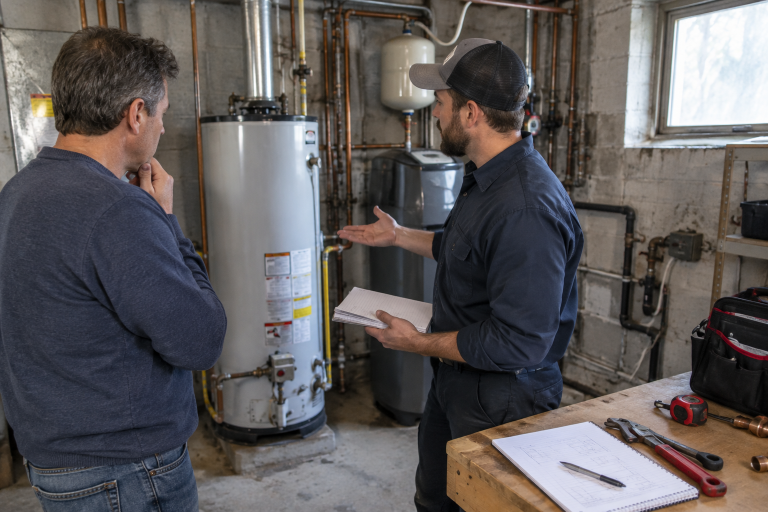
A practical planning worksheet can make the decision clearer:
- Count the people who regularly use hot water in the home.
- Identify the busiest hour, such as weekday mornings or evenings.
- List which fixtures or appliances may run simultaneously.
- Note recurring shortages, slow recovery, or inconsistent temperatures.
- Compare those needs with the unit’s stated performance information.
For example, two showers running while a dishwasher operates create a different demand profile than one shower and occasional handwashing. Homeowners comparing on-demand equipment can review how flow rate and temperature rise affect demand water heaters before relying on a general claim that a tankless system provides unlimited hot water.
Fuel, Electrical Service, and Heat Pump Factors
Natural gas, propane, standard electric resistance heating, and heat pump technology each have different infrastructure needs. The available utility service may narrow the choices before efficiency ratings are even considered. A gas-fired replacement may need adequate gas-line capacity and compliant venting. At the same time, an electric or heat pump option may require a review of panel capacity, circuit availability, and wiring.
Utility rates also matter. Energy costs vary by provider, fuel type, household usage, and time. Comparing local electricity and gas costs with estimated annual energy use is more useful than relying on broad savings promises. The Uniform Energy Factor, often abbreviated as UEF, is a standardized rating that helps compare water heater efficiency, but it does not replace proper sizing.
When Tankless May Be a Good Fit
A tankless water heater can be a strong option for a Lehi home with limited utility-room space or a household that wants to reduce standby heat loss from stored water. When properly sized, it can provide continuous hot water for extended use. However, continuous does not mean unlimited flow at every fixture. Several showers, a tub fill, and appliance use at once can exceed a unit’s capacity.
Tankless installation may also involve changes to venting, combustion-air arrangements, gas piping, electrical service, condensate drainage, or plumbing. Mineral buildup can affect performance, so routine service is especially important where water conditions call for it.
Installation Requirements and Long-Term Costs
The existing water heater location may not accommodate every replacement option. A complete installation review should consider clearances, access for future service, plumbing connections, drainage, venting, combustion air where applicable, and local permitting requirements. Proper sizing matters because undersized equipment can disappoint during peak use, while oversized equipment can add cost without solving the right problem.
What to Compare in Written Estimates
- Equipment model, capacity, flow rate, or first-hour rating.
- Fuel type and efficiency rating.
- Venting, gas piping, electrical, drainage, and code-related work.
- Permit responsibilities and removal of the old water heater.
- Warranty terms and required maintenance.
- Total installed price, rather than equipment price alone.
Maintenance and Service Life
All water heaters benefit from inspection and manufacturer-recommended maintenance. Tank units may need attention to sediment buildup and anode-rod condition. Tankless units may need flushing or descaling when mineral content affects the heat exchanger. Heat pump water heaters may require attention to filters, condensate drainage, and the surrounding installation area.
Service life depends on water quality, installation quality, operating conditions, maintenance, and usage. Easy access for service can reduce future hassle and make routine care more likely to happen on schedule.
A Simple Water Heater Selection Process
- Measure the available installation space.
- Review gas, propane, and electrical service.
- Estimate peak hot-water demand.
- Compare tank, tankless, heat pump, and point-of-use options.
- Review performance ratings, warranties, and maintenance needs.
- Identify required installation upgrades.
- Compare total ownership costs, not just the initial quote.
- Choose the system that fits the home’s real needs.
Common Questions Homeowners Ask
Is a tankless water heater always more efficient?
Not always in the same way for every household. Efficiency, sizing, fuel type, installation quality, and actual hot-water habits all affect results.
Can one water heater supply multiple showers?
Yes, when it is properly sized. The important question is how much hot-water flow is needed simultaneously and, for tankless equipment, how much temperature rise is required.
Is a heat pump water heater right for every home?
No. It needs appropriate installation space, airflow, drainage, electrical capacity, and a location where its operating characteristics make sense.
Should a failing water heater be replaced with the same type?
It may be the best choice, but homeowners should first revisit household demand, future remodeling plans, available utilities, space limitations, and anticipated maintenance needs.
Veeramachineni Lalitha

I am Finance Content Writer. I write Personal Finance, banking, investment, and insurance related content for top clients including Kotak Mahindra Bank, Edelweiss, ICICI BANK and IDFC FIRST Bank. My experience details : Linkedin