

Key Operational Challenges for Community Lenders
Community financial institutions, while deeply rooted in their local economies, often find themselves at a disadvantage when competing with larger national mortgage bankers. The landscape of mortgage lending in August 2026 is characterized by increasing complexity, demanding significant resources and specialized expertise. We’ve identified several key operational challenges that frequently hinder smaller lenders:
- Regulatory Compliance Burdens: The mortgage industry is one of the most heavily regulated sectors. Keeping pace with ever-evolving federal and state regulations, including those from the Consumer Financial Protection Bureau (CFPB) and various state licensing bodies, requires continuous monitoring, specialized legal counsel, and robust internal controls. For smaller institutions, dedicating sufficient staff and budget to this intricate compliance framework can be overwhelming, diverting resources from core business growth. The costs associated with non-compliance, including fines and reputational damage, are simply too high to risk.
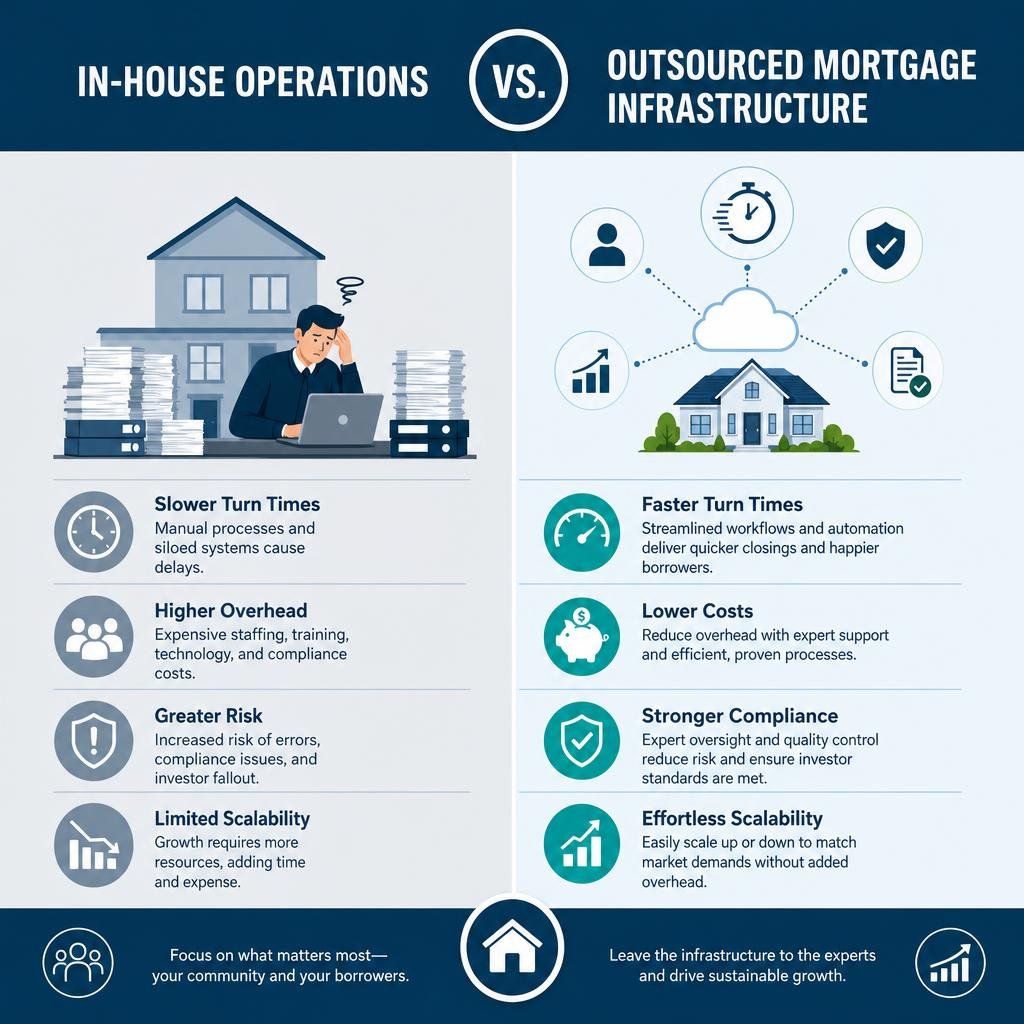
- Operational Overhead and Scalability: Maintaining an in-house mortgage department involves substantial fixed costs: salaries for processors, underwriters, closers, and compliance officers; investment in technology infrastructure; and ongoing training. For institutions with fluctuating loan volumes, these fixed costs can make it difficult to maintain profitability during slower periods. Scaling operations up or down to meet market demand efficiently without compromising service quality is a constant struggle. Legacy systems, often characterized by manual processes and disparate data silos, further exacerbate these inefficiencies, leading to longer processing times and higher error rates.
- Access to Technology and Innovation: Large mortgage bankers benefit from economies of scale, allowing them to invest heavily in cutting-edge loan origination systems (LOS), customer relationship management (CRM) tools, and digital point-of-sale (POS) platforms. Community lenders, however, often struggle to afford or effectively implement these sophisticated technologies. Without modern tools, they risk falling behind in efficiency, data security, and the ability to offer the seamless, digital-first borrower experience that today’s consumers expect. The “loan manufacturing” process, from application to closing, becomes cumbersome and slow.
How Modern Mortgage Lending Solutions Level the Playing Field
In response to these challenges, modern mortgage lending solutions offer a strategic pathway for community financial institutions to not only survive but thrive. By leveraging a comprehensive, turnkey infrastructure, smaller lenders can effectively level the playing field against their larger counterparts. This approach allows them to access enterprise-grade technology, specialized expertise, and robust operational support without the prohibitive costs and complexities of building everything in-house.

One of the most significant advantages of partnering with an external mortgage operations provider is gaining access to sophisticated secondary marketing capabilities and preferred investor relationships. While a large national player might operate as a direct full-service mortgage lender, handling every aspect of the loan lifecycle internally and dictating terms, community lenders often struggle to secure competitive pricing and diverse product offerings from investors. A shared infrastructure, built on years of established relationships and consistent performance, can unlock these opportunities. This means community institutions can offer a wider range of competitive products, better pricing, and more flexible terms to their borrowers, directly impacting their ability to attract and retain customers. This collaborative model empowers community lenders to focus on what they do best: building strong local relationships and serving their communities, while the operational heavy lifting is managed by experts.
Technology Tools and Workflow Automation
The core of any effective mortgage lending solution lies in its technology and workflow automation. These tools are designed to streamline every stage of the loan process, from initial application to post-closing.
- Digital Point-of-Sale (POS) Portals: Modern POS systems, such as SimpleNexus, provide a user-friendly interface for borrowers to apply for loans, upload documents, and track their application status from any device. This significantly enhances the borrower experience by offering convenience and transparency, reducing friction points, and speeding up the initial application phase. For lenders, it means faster document collection and improved data accuracy.
- Customized Loan Origination Systems (LOS): Beyond basic functionality, a robust LOS is customized to optimize workflows, automate routine tasks, and integrate seamlessly with other systems. This customization ensures that the platform aligns with the lender’s specific processes and compliance requirements, reducing manual data entry, minimizing errors, and accelerating loan processing times. The system acts as a central hub for all loan-related activities.
- Marketing Automation & CRM Tools: Attracting new borrowers and nurturing existing relationships is crucial for growth. Integrated CRM and marketing automation tools enable lenders to manage prospect pipelines, implement targeted marketing campaigns, and maintain consistent communication with borrowers throughout their homeownership journey. This includes automated follow-ups, personalized messages, and valuable content, all designed to build loyalty and drive repeat business.
- Efficient Document Collection and Management: One of the most time-consuming aspects of mortgage lending is document collection and verification. Advanced platforms facilitate secure digital document submission, automated indexing, and intelligent data extraction. This not only speeds up the process but also improves data integrity and reduces the risk of missing or incorrect information, which is vital for compliance and investor delivery.
Essential Infrastructure and Operations in Mortgage Lending Solutions
Beyond technology, a truly comprehensive mortgage lending solution provides a complete “loan manufacturing” infrastructure. This encompasses a suite of operational support services that handle the intricate details of loan processing, allowing community lenders to focus on client acquisition and relationship management.
- Fulfillment Services: These services cover the entire spectrum of loan production, from initial application through to closing and post-closing. This includes processing, underwriting, and closing functions, all managed by experienced professionals who specialize in these areas. By outsourcing these labor-intensive tasks, community financial institutions can reduce their operational headcount and associated overhead, freeing up internal resources.
- Product Placement & Scenario Help Desk: The mortgage market is dynamic, with countless loan products and eligibility requirements. Navigating these complexities can be challenging. A dedicated product placement and scenario help desk provides immediate expert guidance on loan product suitability, complex underwriting scenarios, and investor guidelines. This ensures that loan officers can confidently recommend the right products to borrowers, even for niche or challenging situations, without extensive internal research. This support allows loan officers to focus on sales and client management rather than getting bogged down in product minutiae.
- Loan Pricing Engines and Lock Desks: Access to competitive pricing is paramount. Advanced loan pricing engines allow lenders to quickly generate accurate, real-time quotes based on current market conditions and investor matrices. Integrated lock desks facilitate efficient execution of investor locks, ensuring that borrowers receive the best available rates and that lenders can manage their interest rate risk effectively. This capability is often out of reach for smaller institutions operating independently.
Streamlining Underwriting, Closing, and Compliance Support
The backbone of a secure and efficient mortgage operation lies in robust underwriting, closing, and compliance protocols. Modern mortgage lending solutions offer comprehensive support in these critical areas, mitigating risk and ensuring quality.
- Loan-Level Compliance Reviews: With the intricate web of regulations, ensuring compliance at every stage of the loan lifecycle is non-negotiable. These solutions incorporate multi-stage loan-level compliance reviews, scrutinizing every document and process against federal, state, and investor requirements. This proactive approach identifies potential issues early, preventing costly errors, delays, and regulatory penalties. It offers peace of mind that loans are manufactured to the highest compliance standards.
- Specialized Underwriting Solutions: Complex loan scenarios, such as those involving self-employed borrowers, unique property types, or specific government programs, often require specialized underwriting expertise. Outsourced solutions provide access to a team of seasoned underwriters who can navigate these intricacies, ensuring sound credit decisions while adhering to all guidelines. This allows community lenders to expand their product offerings and serve a broader range of borrowers without needing to hire and train specialized in-house staff.
- Post-Closing Quality Control and Risk Mitigation: The work doesn’t end at closing. Post-closing quality control reviews are essential for verifying the accuracy and completeness of loan files before they are sold to investors. These reviews help identify any remaining discrepancies, ensuring investor salability and reducing repurchase risk. By maintaining high standards throughout the entire process, these solutions contribute to a strong reputation and stable investor relationships.
Enhancing Borrower Experience and Processing Efficiency
The borrower experience is a critical differentiator. Modern mortgage lending solutions are designed to make the loan process as smooth, transparent, and efficient as possible, benefiting both the borrower and the lender.
- Digital Point-of-Sale (POS) and Automated Communications: As mentioned earlier, digital POS portals empower borrowers with self-service options. This is complemented by automated communication workflows that keep borrowers informed at every step. From application submission confirmations to status updates and document requests, timely and clear communication reduces borrower anxiety and the need for constant follow-ups, enhancing satisfaction.
- Improved Turn Times: By automating manual tasks, streamlining workflows, and centralizing data, these solutions drastically reduce loan processing times. Faster turn times mean borrowers can close on their homes more quickly, which is a significant competitive advantage in a fast-moving market. For lenders, it translates to higher loan officer productivity and greater capacity for originating more loans.
- Enhanced Borrower Engagement: Beyond just speed, the digital tools foster greater engagement. Borrowers can easily upload documents, e-sign disclosures, and communicate securely with their loan officers. This interactive experience builds trust and makes the often-stressful mortgage process feel more manageable and transparent, leading to higher satisfaction and positive referrals.
Strategic Executive Leadership and Investor Relations
A crucial,, component of successful mortgage lending solutions is the strategic guidance and deep industry expertise provided by an experienced management team. This leadership is invaluable for community financial institutions navigating the complexities of the mortgage market.
The executive management team behind leading mortgage infrastructure providers often brings decades of collective experience to the table. For instance, some providers boast an executive management team with more than 100 years of combined experience in the mortgage business. This depth of knowledge is not merely theoretical; it’s practical, hands-on experience gained across various market cycles and regulatory environments. This team plays a pivotal role in supporting lenders’ strategic and compliance needs by offering guidance on market trends, regulatory changes, and best practices for operational efficiency. Their seasoned perspective helps community lenders make informed decisions, mitigate risks, and capitalize on emerging opportunities.
Leveraging Expert Guidance and Mortgage Lending Solutions
This executive oversight extends directly to secondary market execution and investor relations. Smaller lenders often struggle to establish direct relationships with a wide array of correspondent investors or to negotiate favorable terms. By leveraging the established reputation and volume of a larger, proven platform, community institutions gain access to a broader network of investors, improving product offerings and pricing. The platform’s expertise in managing lock desks and executing investor locks ensures that lenders can offer competitive rates while effectively managing their exposure to market fluctuations.
Furthermore, this strategic partnership allows community lenders to focus their internal resources on what they do best: serving their local communities and fostering client relationships. Instead of dedicating valuable time and personnel to the intricate details of compliance, underwriting, and secondary marketing, they can concentrate on building their loan officer teams and expanding their market reach. For instance, understanding how to effectively locate mortgage loan officers who align with their community-focused mission becomes a primary objective, knowing that the operational backbone is robust and reliable. This strategic allocation of resources is a game-changer for institutions aiming for sustainable growth.

Measuring the Impact of Outsourced Mortgage Infrastructure
The real value of partnering with a comprehensive mortgage lending solution becomes evident when we examine its tangible impact on community financial institutions. The benefits extend beyond mere cost savings, touching upon scalability, sales growth, investor relations, and overall operational quality.
- Enhanced Scalability: One of the primary advantages is the ability to scale operations effortlessly. When loan volumes increase, the outsourced infrastructure can absorb the additional workload without requiring the community lender to hire more staff or invest in new technology. Conversely, during slower periods, the fixed costs associated with an in-house department are significantly reduced, maintaining profitability. This flexibility allows institutions to respond dynamically to market conditions.
- Accelerated Sales Growth: By offloading operational burdens, loan officers are freed from administrative tasks and can dedicate more time to sales, relationship building, and community engagement. This increased focus on origination, combined with competitive products and pricing, directly contributes to higher loan volumes and accelerated sales growth. The ability to offer a superior borrower experience also drives positive referrals and repeat business.
- Improved Investor Shipping Quality: An outsourced solution, with its rigorous compliance and quality control processes, ensures that loan files are meticulously prepared and meet all investor requirements. This leads to higher investor shipping quality, fewer post-closing issues, and a stronger reputation with investors. This, in turn, can result in better pricing and more favorable terms for future loan sales. One vice president of mortgage sales reported that outsourcing fulfillment operations allowed their department to maintain profitability and scalability while achieving quality shipping to investors, highlighting the direct link between operational excellence and business success.
- Positive Client Feedback and Testimonials: The ultimate measure of success often comes from client satisfaction. Community financial institutions that partner with these solutions frequently report significant improvements in efficiency, compliance, and overall competitiveness. These positive experiences serve as powerful testimonials to the value and impact of such partnerships, demonstrating how they enable smaller lenders to compete effectively with larger players.
Frequently Asked Questions about Mortgage Operations
Navigating the complexities of modern mortgage lending often brings forth a series of common questions for community financial institutions. Here, we address some of the most pressing inquiries regarding mortgage operations and how specialized solutions can provide answers.
How do smaller lenders gain access to correspondent investors?
Smaller lenders often face significant hurdles in establishing direct relationships with a diverse range of correspondent investors. This is primarily due to the institutional reputation, volume requirements, and sophisticated secondary marketing infrastructure typically demanded by these investors. Modern mortgage lending solutions bridge this gap by leveraging their established reputation and aggregated loan volume. They act as an intermediary, providing community lenders with access to a broad network of investors that they might not be able to secure independently. This partnership approach utilizes the provider’s long-standing investor relations management and robust secondary marketing capabilities, enabling smaller institutions to offer a wider array of competitive products and secure better pricing for their borrowers. This shared infrastructure essentially grants them the negotiating power and credibility of a much larger entity.
What services are included in a complete loan manufacturing infrastructure?
A complete loan manufacturing infrastructure, as offered by comprehensive mortgage lending solutions, encompasses a wide array of services designed to manage the entire loan lifecycle efficiently and compliantly. These services typically include:
- Processing: Initial loan setup, document collection and verification, ordering appraisals and title reports, and preparing the loan for underwriting.
- Underwriting: Thorough credit analysis, income and asset verification, property valuation review, and ensuring adherence to all loan program and investor guidelines. This often includes specialized support for complex scenarios.
- Closing: Preparation of closing documents, coordination with title companies and attorneys, and ensuring all conditions are met for a smooth loan closing.
- Post-Closing: Quality control reviews, ensuring compliance with all regulatory and investor requirements, and preparing the loan for sale to the secondary market.
- Compliance Services: Loan-level compliance reviews at multiple stages, ensuring adherence to federal, state, and investor regulations, and mitigating risk.
- Secondary Marketing: Access to pricing engines, lock desks, and investor relations management to secure competitive pricing and efficient loan sales.
- Technology Tools: Digital point-of-sale (POS) portals, customized Loan Origination Systems (LOS), and CRM tools to enhance efficiency and borrower experience.
This integrated approach ensures that every step of the loan process is managed by experts, leveraging advanced technology and robust workflows.
How can community financial institutions compete with large mortgage bankers?
Community financial institutions can effectively compete with large mortgage bankers by strategically leveraging turnkey technology, operational outsourcing, and expert executive guidance. Instead of attempting to build and maintain a costly, complex in-house infrastructure that struggles to keep pace with regulatory changes and technological advancements, they can partner with a specialized mortgage lending solution provider. This allows them to:
- Access Enterprise-Grade Technology: Gain immediate access to sophisticated POS, LOS, and CRM platforms without the massive upfront investment or ongoing maintenance.
- Outsource Operational Burdens: Delegate labor-intensive and compliance-heavy tasks like processing, underwriting, and closing to experienced professionals, significantly reducing operational overhead and freeing up internal staff.
- Benefit from Executive Guidance: Leverage the strategic insights and compliance oversight of an executive team with extensive industry experience, ensuring sound decision-making and risk mitigation.
- Improve Investor Access and Pricing: Utilize the provider’s established investor relationships and secondary marketing capabilities to offer a wider range of competitive products and better pricing.
By adopting this model, community financial institutions can maintain their local focus and personalized service while gaining the operational efficiency, technological prowess, and market competitiveness typically associated with much larger organizations. This enables them to offer a superior borrower experience and grow their mortgage business profitably in August 2026 and beyond.
Conclusion
In the dynamic and often challenging environment of mortgage lending, community financial institutions face a critical juncture. The path to sustained success in August 2026 and beyond hinges on their ability to adapt, innovate, and strategically leverage external expertise. As we have explored, modern mortgage lending solutions offer a powerful answer to the key operational challenges faced by smaller lenders, from navigating complex regulatory landscapes to competing with the technological might of large national banks.
By embracing a comprehensive, turnkey infrastructure, community institutions can unlock unparalleled operational efficiency, enhance the borrower experience through digital tools, and gain access to vital investor relations and competitive pricing. The strategic guidance of an experienced management team further empowers them to make informed decisions, mitigate risks, and capitalize on growth opportunities. These solutions enable community financial institutions to maintain their vital role in local economies, providing essential mortgage services while achieving a competitive edge. It’s about empowering them to focus on their core mission: serving their communities with personalized care, backed by world-class operational support and technology.

Veeramachineni Lalitha

I am Finance Content Writer. I write Personal Finance, banking, investment, and insurance related content for top clients including Kotak Mahindra Bank, Edelweiss, ICICI BANK and IDFC FIRST Bank. My experience details : Linkedin