

The Core Principles of Strategic Financial Planning
 In today’s rapidly evolving economic environment, business owners and executives face a constant deluge of decisions, from managing daily cash flow to planning for long-term growth. It’s easy to get caught up in the immediate, but true success hinges on looking ahead and establishing a clear financial roadmap.
This is where strategic financial planning becomes indispensable. It’s a disciplined approach that ensures your financial resources are not only aligned with your overarching business objectives but also support your personal wealth aspirations. For many, this comprehensive approach extends to Strategic wealth planning for business owners, ensuring all aspects of their financial lives work in concert.
Throughout this extensive guide, we will explore the core principles of strategic financial planning, delving into everything from optimizing business operations and managing assets like mortgages, to strategically exploring alternative investments. Our aim is to help you navigate market cycles, allocate capital wisely, and build a resilient financial future for both your enterprise and your personal well-being.
Who This Is For
This guide is designed for a diverse group of forward-thinking individuals and entities, including small business owners aiming for sustainable expansion, mid-sized enterprise executives navigating complex markets, Virginia professionals seeking to optimize their financial trajectory, Charlottesville entrepreneurs building innovative ventures, Richmond firm partners planning for generational wealth, Roanoke family offices managing intricate portfolios, and Alexandria consultants advising on strategic growth. If you’re looking to transform your financial future from reactive to proactive, this guide is for you.
Symptoms of a Rudderless Strategy
Without a clear strategic financial plan, businesses often exhibit tell-tale signs of a “rudderless” approach. These signals indicate a lack of long-term vision and can hinder sustainable growth:
- Insufficient Cash Reserves: A common challenge, with a striking 38% of small businesses in the U.S. struggling with inadequate cash on hand, leaving them vulnerable to unexpected expenses or market downturns.
- Siloed Financial Decisions: Departments making financial choices in isolation, leading to inefficiencies, misallocated resources, and a disjointed overall strategy.
- Reactive Budgeting: Focusing solely on past performance or immediate needs rather than proactively planning for future opportunities and challenges.
- Stagnant Growth: A plateau in revenue or market share, often a symptom of failing to identify and invest in high-impact opportunities.
- Lack of Clear KPIs: Without measurable financial targets, it becomes impossible to track progress, evaluate success, or make data-driven adjustments.
These symptoms highlight the critical need for a structured approach that integrates financial foresight with operational execution.
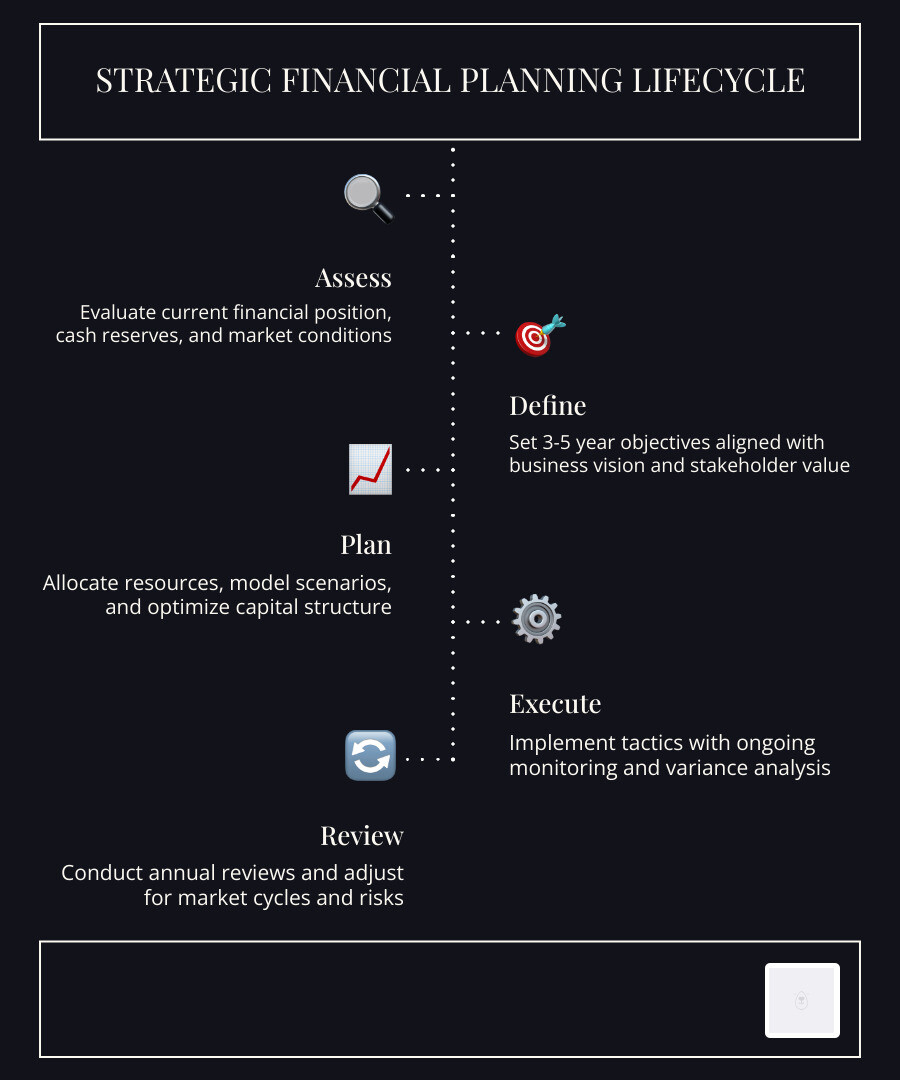
Strategic financial planning is the overarching process of aligning an organization’s long-term goals with its financial resources. Unlike short-term budgeting or tactical financial management, it typically spans a three to five-year horizon, focusing on how capital can be best utilized to achieve sustained growth and competitive advantage. This involves making informed decisions about resource allocation, capital structure, and managing stakeholder value, all while anticipating future market conditions. For a deeper dive into how a comprehensive approach can transform your business, consider exploring concepts around Effective strategic financial planning.
Why This Decision Matters
Embracing strategic financial planning is not merely an administrative task; it’s a fundamental commitment to your business’s long-term viability and success. In the dynamic economic landscape of May 2026, characterized by rapid technological shifts and evolving market demands, this proactive approach offers several critical advantages:
- Stability: It provides a robust framework for navigating economic uncertainties, allowing businesses to build resilience and weather market volatility.
- Flexibility: While long-term, a strategic plan is a living document, designed to be adaptable to new opportunities or unforeseen challenges.
- Long-Term Outcomes: It shifts focus from immediate gains to sustainable value creation, ensuring decisions today contribute to future prosperity.
- Risk Mitigation: By identifying potential financial risks early, businesses can develop contingency plans and build buffers, protecting their assets and operations.
- Sustainable Growth: It guides capital allocation to the most promising areas, fostering organic and inorganic growth that is both robust and enduring.
The Difference Between Strategy and Tactics
Understanding the distinction between strategic and tactical financial management is crucial. Strategic planning operates at a macro-level, defining where the business wants to go (its mission and vision) and why. It’s about setting the long-term direction, often over a 3-5 year period, and determining the overall financial viability required to achieve those ambitious goals. This includes decisions on capital structure, major investments, and market positioning.
Tactical financial management, on the other hand, focuses on the micro-level execution of the strategic plan. It deals with the day-to-day operations, short-term positioning, and seizing near-term opportunities, typically within a one-year budget cycle. While essential for immediate operational efficiency, tactical decisions without a strategic compass can lead to short-sightedness and misalignment with long-term objectives. Strategic planning ensures long-term solvency, while tactical efforts manage the immediate cash flow and resource deployment to support that larger vision.
Feature Tactical Financial Management Strategic Financial Planning Time Horizon Short-term (e.g., daily, monthly, annual budget) Long-term (e.g., 3-5 years, sometimes 10+ years) Focus Day-to-day operations, immediate cash flow, expense control Overall direction, long-term goals, competitive advantage Scope Operational efficiency, resource deployment Market position, capital structure, major investments Objective Achieve short-term targets, manage current financial health Ensure long-term viability, sustainable growth, value creation Key Activities Budgeting, forecasting, variance analysis, cash management Scenario planning, financial modeling, risk assessment, capital allocation If this raises questions about how to best integrate these two crucial aspects for your business, we’re happy to talk through what makes sense for your unique situation.
Practical Considerations: From Real Estate to Alternative Assets

For business owners, strategic financial planning extends beyond the balance sheet to encompass personal wealth and asset diversification. This includes a careful consideration of traditional assets like real estate, where integrating mortgage planning with overall financial goals can optimize cash flow and leverage. Beyond conventional investments, exploring alternative assets offers unique opportunities for diversification and growth. For those looking to hedge against inflation or diversify their portfolio, understanding Strategic precious metals planning can be a valuable component of a comprehensive financial strategy.
Strategic planning also involves evaluating debt versus equity financing, preparing for significant liquidity events (like a business sale or IPO), and implementing robust asset protection strategies. Tax-efficient growth is a paramount concern, ensuring that wealth accumulation is maximized while minimizing tax liabilities across all asset classes.
Evaluating Capital Allocation
A cornerstone of strategic financial planning is the meticulous evaluation of capital allocation. This process is about directing financial resources to the highest-impact opportunities that align with the company’s long-term vision. It requires a deep understanding of the business model, distinguishing between fixed and variable costs, and making informed decisions about where to invest.
Businesses must consider various growth avenues:
- Organic Growth: Investing in existing operations, product development, or market expansion.
- Inorganic Expansion: Pursuing mergers, acquisitions, or strategic partnerships.
Crucially, strategic capital allocation also involves robust contingency planning, preparing for both downside risks (e.g., economic downturns, supply chain disruptions) and upside potential (e.g., unexpected market opportunities). This ensures flexibility and resilience, allowing the business to adapt and thrive regardless of external conditions.
Reassuring Value Statement
Navigating the complexities of wealth requires a steady hand and a clear roadmap. By focusing on underlying principles rather than market noise, business owners in the Richmond area can build a foundation that remains resilient across cycles. Our approach emphasizes clarity, long-term vision, and a deep understanding of your unique circumstances, ensuring your financial strategy is robust enough to adapt to any challenge.
Integrating FP&A and Strategic Financial Planning for Growth

Financial Planning & Analysis (FP&A) plays a pivotal role in translating strategic vision into actionable financial plans. It’s the engine that drives data-driven decision-making, utilizing tools like scenario planning, forecasting, and financial modeling to project future performance and assess the financial implications of different strategic choices. FP&A professionals are instrumental in resource optimization, ensuring that every dollar spent aligns with organizational goals and contributes to long-term growth. Their insights provide leadership with the clarity needed to make informed decisions and steer the business effectively.
The Role of FP&A in Strategic Financial Planning
FP&A teams are the bridge between high-level strategy and operational reality. They are responsible for:
- Variance Analysis: Regularly comparing actual financial performance against planned budgets and forecasts to identify deviations and their root causes.
- Rolling Projections: Continuously updating forecasts based on new information, ensuring financial plans remain relevant and agile.
- Business Intelligence: Gathering, analyzing, and interpreting financial data to provide actionable insights to management.
- Strategic Financial Mapping: Connecting operational decisions and cost drivers (e.g., procurement, freight policies) directly to financial outcomes.
- Cost Driver Identification: Pinpointing the key factors that influence expenses and revenue to optimize profitability.
- Departmental Alignment: Ensuring that departmental budgets and operational plans are synchronized with corporate financial goals.
- 3-5 Year Forecasting: Developing long-range financial outlooks that support the strategic planning horizon.
Measuring Success in Strategic Financial Planning
To effectively gauge the success of strategic financial planning, businesses must track a range of key performance indicators (KPIs) and financial metrics. These provide objective measures of progress and highlight areas for adjustment:
- Cash Runway: Crucial for early-stage and high-growth companies, this metric indicates how long a business can operate before running out of cash, calculated by dividing current funds by the burn rate.
- Rule of 40: A principle stating that a company’s growth rate and profit margin should ideally sum to 40% or more, indicating a healthy balance between growth and profitability, particularly for SaaS businesses.
- LTV/CAC Ratio: The ratio of Customer Lifetime Value to Customer Acquisition Cost. An ideal ratio for early-stage, high-growth companies is 3:1, suggesting efficient customer acquisition. A ratio of 6:1 might indicate under-spending on customer acquisition, while 1:1 suggests over-spending.
- Net Dollar Retention (NDR): Also known as Net Revenue Retention (NRR), this metric measures the percentage of recurring revenue retained from existing customers over a specific period, crucial for subscription-based models.
By consistently monitoring these and other relevant metrics, businesses can ensure their strategic financial planning is on track to deliver desired outcomes and achieve their Strategic wealth planning for business owners objectives.
A Framework for Virginia Business Owners
For business owners across Virginia, from the bustling streets of Richmond to the historic charm of Charlottesville and the growing markets of Roanoke and Alexandria, a structured strategic framework is vital. This framework helps translate broad aspirations into concrete, measurable actions. Tools like SWOT analysis (Strengths, Weaknesses, Opportunities, Threats) provide a comprehensive internal and external assessment, while frameworks like the Strategy Pyramid help cascade the overall mission and vision into specific, actionable departmental targets. This ensures that every operational action contributes directly to the overarching strategic goals.
Practical Steps for Implementation
Implementing a strategic financial plan is an iterative process that requires discipline and ongoing commitment. Here are the practical steps we recommend:
- Define Objectives: Clearly articulate specific, measurable, achievable, relevant, and time-bound (SMART) financial and business goals.
- Assess Current Position: Conduct a thorough review of your financial health, including income statements, balance sheets, cash flow, and non-financial factors.
- Develop Forecasts: Create long-range financial forecasts (3-5 years) using scenario planning and sensitivity analysis to anticipate various outcomes.
- Allocate Resources: Strategically deploy capital and human resources to initiatives that offer the highest return and align with your objectives.
- Monitor Progress: Establish KPIs and regularly track performance against your plan, utilizing dashboards and financial reporting.
- Annual Reviews: Conduct comprehensive annual reviews to reassess your strategy, update forecasts, and make necessary adjustments based on market changes or internal performance.
- Monthly Financial Checkpoints: Implement monthly or quarterly financial reviews to ensure tactical operations remain aligned with strategic goals.
If you’d like a second opinion or a clearer framework tailored to your specific business needs, we’re available to help.
Frequently Asked Questions about Strategic Financial Planning
What is the difference between a budget and a strategic plan?
A budget is a short-term tactical tool, usually covering one year, detailing expected income and expenditures. In contrast, a strategic plan is a long-term roadmap spanning three to five years (or more) that aligns financial resources with the company’s overarching vision and competitive strategy. The budget serves to execute a portion of the strategic plan.
How often should we update our strategic financial plan?
While the strategic vision is long-term, the plan itself should be a living document. We recommend reviewing it at least annually to assess progress, incorporate new market insights, and adjust for any significant internal or external changes. Significant shifts in the economic landscape, competitive environment, or business performance may warrant more frequent adjustments.
Why do small businesses in Virginia need this level of planning?
Whether operating in the growing tech hub of Richmond, the tourism-driven economy of Charlottesville, the industrial base of Roanoke, or the federal contractor landscape of Alexandria, Virginia businesses face unique local economic shifts and competitive pressures. Strategic planning ensures that precious cash reserves and limited resources are used to build long-term resilience and seize growth opportunities, rather than merely meeting immediate payroll or reacting to daily challenges.
What role does risk management play in this process?
Risk management is a foundational element of strategic financial planning. It involves identifying potential threats—such as supply chain volatility, interest rate fluctuations, cybersecurity risks, or competitive shifts—and building financial and operational buffers to protect the organization’s core mission and assets. A robust risk framework allows businesses to anticipate and mitigate potential disruptions, safeguarding their long-term stability.
How do alternative assets fit into a business owner’s strategy?
Alternative assets, such as real estate, private equity, venture capital, or precious metals, provide crucial diversification that can hedge against traditional market volatility and inflation. For a business owner, these assets can offer a layer of protection for their total net worth, potentially generating uncorrelated returns and enhancing long-term wealth accumulation beyond conventional stock and bond portfolios.
Conclusion
Thoughtful planning is not about predicting the future, but about being prepared for it. By grounding your decisions in clear principles and a long-term perspective, you can navigate the journey with confidence and clarity, ensuring both your business and personal wealth are positioned for enduring success.
Veeramachineni Lalitha

I am Finance Content Writer. I write Personal Finance, banking, investment, and insurance related content for top clients including Kotak Mahindra Bank, Edelweiss, ICICI BANK and IDFC FIRST Bank. My experience details : Linkedin