

Introduction: Engineering Beyond the Limits of Traditional Materials
 Modern industrial challenges often push materials to their breaking point. High temperatures, harsh chemicals, and constant mechanical stress can cause traditional materials to fail. This leads to costly downtime and safety concerns.
We need materials that can perform reliably under these extreme conditions. This is where thermoset composites come in. They are specially designed to thrive where others struggle.
In this guide, we will explore thermoset composite materials. We will look at what makes them unique, their key properties, and the many advantages they offer. We will also find how they are used to create robust components for the most demanding industries. Join us as we learn how these advanced materials are engineering solutions beyond the limits of traditional options.
What Are Thermoset Composite Materials?
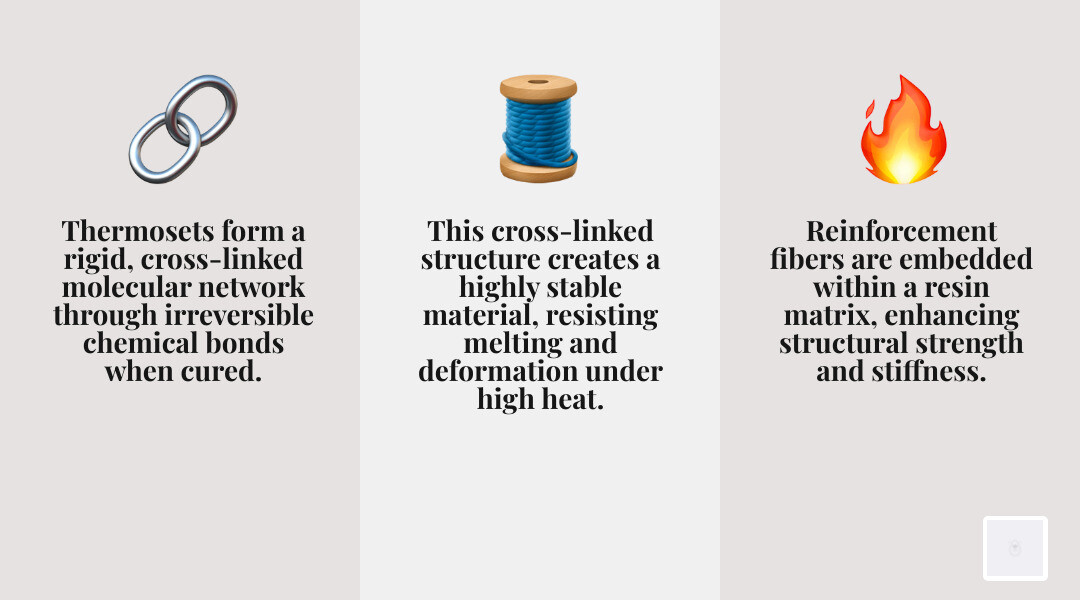
At its core, a thermoset is a polymer material that undergoes an irreversible chemical bond when cured. Unlike thermoplastics, which can be melted and reshaped multiple times, thermosets form a rigid, cross-linked network structure during processing. This cross-linking process creates a highly stable material that resists further melting or deformation when exposed to heat.
Thermoset composites improve this fundamental stability by embedding reinforcement fibers within a resin matrix. This combination leverages the strength and stiffness of the fibers with the chemical and thermal resistance of the thermoset resin, resulting in materials with exceptional performance characteristics.
The historical origins of plastic molding compounds, and indeed the “Plastic Age” itself, are often traced back to the invention of Bakelite in 1907 by Dr. Leo Hendrik Baekeland. Bakelite, a phenol-formaldehyde resin, was the first fully synthetic thermoset plastic, revolutionizing manufacturing with its electrical insulating properties and heat resistance. This invention laid the groundwork for countless thermoset materials that followed.
The Core Components: Resins and Reinforcements
The performance of a thermoset composite is largely determined by its constituent parts: the resin matrix and the reinforcement fibers.
Common thermoset resins include:
- Phenolic: Known for excellent heat resistance, dimensional stability, and good electrical properties. Often used in automotive, electrical, and appliance applications.
- Epoxy: Offers high strength, excellent adhesion, and superior chemical resistance. Widely used in aerospace, electronics, and structural applications.
- Polyester: Versatile and cost-effective, providing good mechanical properties and chemical resistance. Frequently seen in Sheet Molding Compound (SMC) and Bulk Molding Compound (BMC) applications.
- Silicone: Exhibits exceptional thermal stability, flexibility, and electrical insulation properties across a wide temperature range. Used in high-temperature seals, gaskets, and electrical components.
Reinforcement materials are crucial for imparting mechanical strength and stiffness. The most common include:
- Glass fibers: Provide high strength-to-weight ratio and are cost-effective.
- Carbon fibers: Offer superior stiffness, strength, and lightweight properties, often used in high-performance applications.
- Aramid fibers: Known for their high tensile strength, impact resistance, and vibration damping properties.
Historically, various filler materials were incorporated into plastic molding compounds to modify properties or reduce cost. As recently as the mid-1980s, asbestos was commonly used as a filler material in plastic molding compounds. While it offered benefits like heat resistance and strength, the associated health risks—including mesothelioma and lung cancer—have led to its complete discontinuation in modern materials. Today, safer alternatives like mineral fillers, glass beads, and other synthetic fibers are used.
Understanding Thermoset Composite Materials vs. Thermoplastics
The fundamental difference between thermoset composites and thermoplastics lies in their molecular structure and behavior when heated.
- Molecular Structure: Thermoplastics consist of long linear or branched polymer chains that are held together by relatively weak intermolecular forces. When heated, these forces weaken, allowing the chains to move past each other, making the material melt and flow. Thermosets, on the other hand, form a permanent, three-dimensional cross-linked network during curing. This network prevents the polymer chains from moving independently.
- Recyclability: Due to their ability to melt and reshape, thermoplastics are generally recyclable. Thermosets, once cured, cannot be re-melted or reshaped, making traditional recycling methods challenging. However, advancements in chemical recycling and mechanical grinding for use as fillers are emerging.
- Performance Under Heat: This is a major advantage for thermosets. Their cross-linked structure provides superior thermal stability, allowing them to maintain their mechanical properties at much higher temperatures than most thermoplastics. Thermoplastics soften and lose strength as they approach their melting point.
- Creep Resistance: Thermosets exhibit excellent creep resistance, meaning they resist deformation under long-term stress, especially at liftd temperatures. This is critical for structural components.
- Dimensional Stability: The rigid network of thermosets results in exceptional dimensional stability, with low thermal expansion and minimal warpage, even under fluctuating temperatures.
Key Properties and Advantages of Thermoset Composites
Thermoset composites offer a compelling suite of properties that make them indispensable in demanding applications. Their unique chemistry and reinforced structure translate into significant advantages:
- High Strength-to-Weight Ratio: By combining strong fibers with a rigid resin matrix, thermoset composites can achieve strength levels comparable to or exceeding metals, often at a fraction of the weight. This is crucial for applications where weight reduction is paramount, such as in aerospace and automotive industries.
- Superior Thermal Stability: The cross-linked molecular structure of thermosets prevents them from melting or flowing at high temperatures. They maintain their structural integrity and mechanical properties even when exposed to extreme heat, characterized by a high Heat Deflection Temperature (HDT).
- Chemical and Corrosion Resistance: Thermoset resins are inherently resistant to a wide range of chemicals, solvents, and corrosive environments. This makes them ideal for components exposed to harsh industrial chemicals, fuels, or saltwater.
- Excellent Electrical Insulation Properties: Many thermoset resins are superb electrical insulators, making them perfect for applications requiring high dielectric strength and arc resistance, such as in switchgear, circuit breakers, and motor components.
- Dimensional Stability Under Load: The rigid, cross-linked network provides exceptional dimensional stability, preventing creep and deformation under sustained mechanical loads, even at liftd temperatures. This ensures precise part geometry and reliable performance over time.

Engineering for Performance: How Properties are Custom
The versatility of thermoset composites stems from the ability to precisely engineer their properties through material formulation and the judicious use of additives and fillers. This allows for tailoring materials to meet highly specific application demands.
For instance, flame retardants can be incorporated to improve fire safety, while UV stabilizers protect components exposed to sunlight. The development of advanced formulations, from general-purpose phenolics to specialized Spaulding thermoset molding compounds, allows engineers to specify materials with precise performance characteristics. This customization extends to selecting the type and length of reinforcing fibers, the resin chemistry, and various modifiers to optimize everything from impact resistance to surface finish. This design flexibility empowers engineers to create components that are not only high-performing but also cost-effective for their intended use.
Comparing Thermosets to Metals
While metals have long been the go-to for structural integrity, thermoset composites present a compelling alternative, often outperforming metals in specific areas. Let’s consider a comparison:
Property Glass-Filled Phenolic Composite (Thermoset) Aluminum (e.g., 6061-T6) Steel (e.g., 1018 Carbon Steel) Strength-to-Weight Ratio Very High (Excellent) High Moderate Corrosion Resistance Excellent (to many chemicals) Good (oxidizes) Moderate (rusts easily) Electrical Conductivity Very Low (Excellent Insulator) Very High High Thermal Conductivity Low (Insulator) High Moderate Heat Deflection Temp. Very High (200-300+ °C) Low (melts ~600°C) Very High (melts ~1400°C) Manufacturing Complexity Moderate (molding) Moderate (machining/forming) Moderate (machining/forming) Weight Reduction Significant potential Moderate potential Low potential This table highlights how thermoset composites can offer advantages in applications requiring lightweight, corrosion-resistant, and electrically insulating properties, often at temperatures where metals might creep or conduct unwanted heat or electricity. The ability of thermoset bulk molding compounds (BMC) to achieve weight reduction of more than 40% over aluminum parts further underscores their potential in specific applications.
Common Manufacturing Processes and Compound Forms
The unique properties of thermoset composites necessitate specific manufacturing processes custom to their curing behavior. The goal is to form the desired part shape while initiating the irreversible cross-linking reaction.
Common manufacturing processes include:
- Compression Molding: This is a widely used method for thermosets. A pre-weighed charge of molding compound (pellets, preforms, or sheets) is placed into a heated, open mold cavity. The mold is then closed under high pressure, forcing the material to flow and fill the cavity. Heat and pressure are maintained until the material cures. This process is excellent for high-volume production of complex, high-strength parts.
- Injection Molding: While more commonly associated with thermoplastics, specialized injection molding techniques are used for thermosets. The thermoset material is heated to a flowable state in a barrel and then injected into a heated mold cavity where it cures. This offers faster cycle times and automation benefits for certain thermoset formulations.
- Transfer Molding: Similar to injection molding, but the thermoset material is first pre-heated in a separate chamber (pot) and then transferred under pressure through sprues and runners into a closed mold cavity. This method is often preferred for parts with delicate inserts or intricate geometries.
The selection of the appropriate manufacturing process depends on several criteria:
- Part Complexity: Intricate geometries and parts with inserts might favor transfer or injection molding.
- Production Volume: Compression molding is highly efficient for high-volume runs, especially for larger parts.
- Material Type: The specific thermoset resin and reinforcement dictate process compatibility.

An In-Depth Look at Specific Thermoset Composite Materials
Beyond general classifications, specific forms of thermoset molding compounds are designed for particular applications and manufacturing processes.
Sheet Molding Compound (SMC) is a ready-to-mold, glass-fiber reinforced polyester material primarily used in compression molding. SMC is provided in rolls weighing up to 1000 kg. Its manufacturing process involves dispersing long strands of chopped fiber (typically longer than 1 inch) onto a bath of thermoset resin, fillers, and additives. This sheet is then matured to a leathery consistency, making it easy to handle and mold. SMC offers advantages such as high-volume production ability, excellent part reproducibility, and cost-effectiveness due to low labor requirements. Its physical properties are impressive, with flexural strength ranging from 120–230 MPa and heat deflection temperatures at 1.82 MPa from 200–260 °C. SMC is widely used in automotive, transit, and demanding electrical and corrosion-resistant applications.
Bulk Molding Compound (BMC), also known as Dough Molding Compound (DMC), is another thermoset composite material, typically polyester-based, but with shorter fibers than SMC (usually less than 1 inch). BMC is a putty-like material that can be compression, injection, or transfer molded.
SMC vs. BMC Applications:
- SMC: Due to its longer fibers, SMC generally provides higher mechanical strength and is often chosen for larger, structural components in automotive body panels, electrical enclosures, and industrial parts.
- BMC: With its shorter fibers and flow characteristics, BMC is suitable for smaller, more intricate parts with complex geometries, such as electrical components, appliance parts, and automotive headlamp reflectors.
Both SMC and BMC are critical for high-volume production, enabling manufacturers to produce complex components with consistent quality and efficiency.
From Raw Material to Finished Part
The journey from a raw thermoset molding compound to a finished component involves a precise sequence of steps:
- Molding Cycle: The process begins with placing the compound into a heated mold. Under pressure, the material flows to fill the cavity.
- Curing Process: Heat and pressure trigger the chemical cross-linking reaction, changing the liquid or semi-solid compound into a rigid, solid part. The curing time varies depending on the material and part thickness.
- Post-Molding Finishing: Once cured, the part is ejected from the mold. Flash (excess material) may be trimmed, and secondary operations like drilling, sanding, or painting can be performed.
- Machining Thermosets: While thermosets are often molded to near-net shape, machining can be necessary for tight tolerances or specific features. However, their hardness and abrasive nature require specialized tooling and techniques.
- Near-Net Shape Molding Advantages: One significant advantage of thermoset molding is the ability to produce parts very close to their final dimensions, minimizing the need for extensive post-processing and reducing material waste.
Applications Across Demanding Industries
The exceptional properties of thermoset composites make them ideal for a vast array of demanding applications across numerous industries. Their ability to withstand harsh conditions where traditional materials would fail provides engineers with reliable and durable solutions.
Key industries leveraging thermoset composites include:
- Aerospace and Defense: For lightweight structural components, interior panels, and high-temperature engine parts.
- Electrical and Electronics: For insulators, switchgear, motor components, circuit boards, and protective enclosures due to their excellent dielectric strength.
- Automotive: For under-hood components, body panels, structural parts, and lighting systems, offering weight reduction and heat resistance.
- Industrial and OEM: For pump housings, bearings, valves, and other machinery components that require chemical resistance, wear resistance, and dimensional stability.
- Medical: For instrument housings, sterilization trays, and specialized equipment requiring chemical resistance and high-temperature performance.
Real-World Use Cases for Thermoset Composites
Let’s dig into specific examples of how thermoset composites are used:
- Aerospace Structural Components: Carbon fiber epoxy composites are routinely used in aircraft fuselages, wings, and interior structures, significantly reducing weight and improving fuel efficiency.
- Electrical Insulators: Thermoset materials like phenolic and epoxy are critical for manufacturing standoffs, bus bar supports, and switchgear components, providing reliable electrical isolation in high-voltage environments.
- Automotive Under-Hood Parts: Components such as valve covers, intake manifolds, and engine mounts are made from thermoset composites to withstand high temperatures, vibrations, and exposure to automotive fluids.
- Industrial Pump Housings: In chemical processing plants, thermoset composites are chosen for pump housings and impellers due to their superior resistance to corrosive liquids and abrasive slurries.
- Bearings: Composite bearing materials, often incorporating thermoset resins, are used in heavy machinery and industrial equipment where high load capacity, low friction, and resistance to harsh environments are required.
- Rotor Vanes: In air tools and sliding vane pumps, thermoset composite rotor vanes offer excellent wear resistance, self-lubrication, and dimensional stability, ensuring efficient and long-lasting operation.
- Medical Device Enclosures: For devices that require frequent sterilization or exposure to cleaning agents, thermoset enclosures provide the necessary chemical resistance and durability.
These examples illustrate the versatility and critical role that thermoset composites play in ensuring performance and reliability in the most challenging environments.
Frequently Asked Questions about Thermoset Composites
How do thermoset composites differ from thermoplastics?
The primary difference lies in their behavior when heated. Thermosets undergo an irreversible chemical reaction (curing) that permanently sets their shape and properties, providing superior stability at high temperatures. This cross-linked structure means they will degrade or char if reheated excessively, rather than melting. Thermoplastics, conversely, can be repeatedly melted and reshaped, which makes them easier to recycle but less stable under heat and load. This distinction is crucial for applications requiring high thermal resistance and dimensional stability.
Can thermoset composites effectively replace metal parts?
Yes, in many applications, thermoset composites can effectively replace metal parts and often offer significant advantages. Thermosets provide a comparable or higher strength-to-weight ratio than many metals, superior corrosion resistance, and excellent electrical insulation. This allows for significant weight reduction, improved energy efficiency, and improved safety in components traditionally made from aluminum, steel, or zinc. For example, in the automotive industry, thermoset composites are increasingly used for structural components to reduce vehicle weight, leading to better fuel economy and reduced emissions.
What are the most important factors when selecting a thermoset material?
When selecting a thermoset material, several critical factors must be considered to ensure optimal performance and longevity. These include the operating temperature range, required mechanical strength and stiffness (e.g., tensile strength, flexural modulus), anticipated chemical exposure, specific electrical insulation requirements (e.g., dielectric strength, arc resistance), and dimensional stability under sustained load or varying temperatures. Additionally, processing considerations, cost-effectiveness, and any specific regulatory compliance (e.g., flame retardancy, food contact) are also vital. Consulting with a materials expert is crucial to accurately match the right resin, reinforcement, and manufacturing process to the specific demands of the application.
Conclusion: Partnering for Performance and Reliability
Thermoset composites provide a powerful solution for engineers facing challenging design requirements that exceed the capabilities of traditional materials. Their unique combination of high strength, low weight, and resistance to heat and chemicals enables the creation of durable, high-performance components. However, open uping these benefits requires a deep understanding of material science and manufacturing processes. By carefully selecting the right compound and process, companies can develop robust parts that perform reliably in the most demanding real-world applications, reducing failures and improving long-term value.
Veeramachineni Lalitha

I am Finance Content Writer. I write Personal Finance, banking, investment, and insurance related content for top clients including Kotak Mahindra Bank, Edelweiss, ICICI BANK and IDFC FIRST Bank. My experience details : Linkedin